Let’s explore how “Data powers AI”. So far we have covered the broad landscape of Artificial Intelligence and discussed the intricate layers of Machine Learning and Deep Learning. We have discussed how neural networks are inspired by our brains, learn to recognize patterns and make decisions.
Let’s discuss; what fuels these powerful digital brains? and What do they run on?
The answer is simple: Data, yes Data powers AI.
You may have heard the phrase, “Data is the new oil.” While oil fueled the industrial revolution, data is the indispensable fuel of the artificial intelligence revolution. Understanding this is not just a technical knowhow but it is crucial for knowing the AI’s power, its limitations, and its future.
Table of Contents
How Data powers AI.
Imagine trying to teach a child without ever showing them anything, telling them anything, or letting them experience anything. It’s impossible. Similarly, AI models, especially those built on Machine Learning and Deep Learning, learn from data.
Why data is so critical:
- Training: AI models are “trained” on massive datasets. Through training process the AI learn patterns, relationships, and make connections.
- Example: To teach an AI to recognize cats, you feed it millions of images labeled “cat” and “not cat.” The AI learns what visual features define a cat.
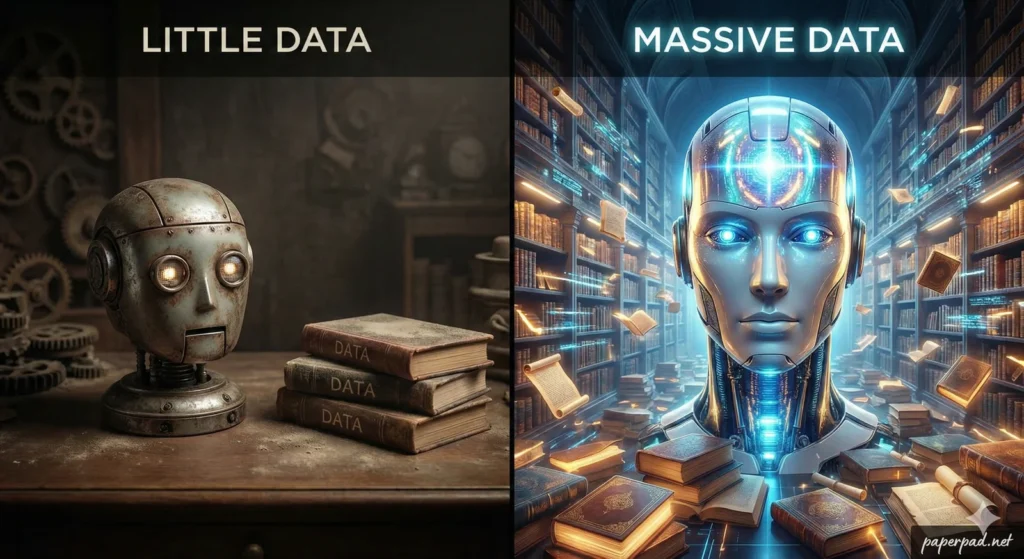
- Accuracy: The quality and quantity of the data directly impact the AI model’s accuracy and its performance. More diverse and relevant data generally leads to better, more robust models.
- Generalization: By Generalization, AI uses what it has learned to handle new situations. For example, If an AI is only shown pictures of white cats, it might struggle to identify a black cat. Diverse data ensures broader applicability.
- Specialization: Specific types of AI require specific data. An AI designed to predict stock prices needs historical financial data, not images of cats.
The Evolution of Data’s Role.
In the early days of AI, programmers manually encoded rules. For instance, “IF the temperature is below 20 degrees, THEN turn on the heater.” This is same as IF THEN ELSE formula and required minimal data.
With the rise of Machine Learning, the paradigm shifted. Instead of rules, we feed data to machines, and it infers the rules. This shift made AI far more powerful and adaptable. Now, with Deep Learning and Generative AI, the hunger for data has become impossible to satisfy. Large Language Models (LLMs) like ChatGPT are trained on internet-scale datasets, often comprising trillions of words.
What Makes “Good” AI Data?
Not all the data is equally good. For AI, “good” data possesses several key characteristics:
- Quantity: Generally, more data is better, especially for complex deep learning models.
- Quality: The data must be accurate, clean, and free from errors or noise. “Garbage in, garbage out” is a fundamental truth in AI.
- Relevance: The data must pertain directly to the problem the AI is trying to solve.
- Diversity/Representativeness: The data should reflect the real-world conditions and variations the AI will encounter. This is crucial for avoiding bias. A dataset full of only one demographic, for example, will lead to an AI that performs poorly or unfairly for others.
- Labeling: For supervised learning, data often needs to be correctly labeled (e.g., this is a “dog” image,” this text expresses “positive sentiment”). This labeling process can be manual and resource-intensive.
How “Data powers AI” Matters to Everyone?
Understanding the significance of data goes beyond the technical aspects of AI, it touches upon ethics, economics, and our daily lives.
- Ethical Implications (Bias): AI systems are like mirrors, they reflect whatever we show them. If the data we use to train them is “dirty or unfair” with human bias, the AI’s decisions will be unfair. If an AI is trained predominantly on data from one demographic or perspective, it might not just copy our mistakes, but may make them worst. Understanding data sources is key to combating algorithmic bias and ensuring fairness.
- Privacy Concerns: Collecting the vast amounts of data needed for AI raises significant privacy questions. How is our data being used? How is it protected? Regulations like GDPR and CCPA are direct responses to these concerns, aiming to give individuals more control over their digital footprint.
- Economic Power: Companies with access to proprietary, high-quality data often have a significant competitive advantage in the AI race. This can lead to market concentration and influence.
- Job Market Transformation: The demand for data scientists, data engineers, and AI ethicists is skyrocketing. Understanding data’s role is crucial for future career paths and adapting to evolving industries.
- Informed Citizen: As AI becomes part of our daily lives, data literacy acts like a shield. It helps us see past the “magic” and understand how these systems actually work.
The Future of Data for AI
The quest for better, more diverse, and ethically sourced data continues. Innovations like synthetic data (AI-generated data that mimics real-world data without privacy concerns) and federated learning (where AI learns from decentralized data without needing to centralize it) are emerging to address current challenges.
Just as the world evolved beyond crude oil to refined fuels and alternative energies, the world of AI data is also undergoing constant refinement and innovation.
Understanding data’s pivotal role is not just about understanding technology; it’s about understanding the engine driving our future.
In our next post we will explore Supervised, Unsupervised, and Reinforcement Learning: The Three Ways AI Learns, and diving deeper into the specific methods AI uses to draw insights from all this data.