
Introduction
Every major AI you have heard of such as ChatGPT, Gemini, tools like “CustomGPT.ai“, writing assistants like “Rytr” all these runs on the same engine under the hood, known as the transformer.
If you ask most people how it works, they have no idea. Technical terms like “attention mechanism,” “positional encoding,” and “feed-forward network” are used often, but they don’t make much sense to the average person.
This guide tells you all in simple words.
You do not need to write any code or possess specialized AI knowledge. By the end of this reading, you will understand how a transformer turns raw text into intelligent responses and why this architecture changed everything after its introduction in 2017.
Table of Contents
What Is a Transformer?
A transformer is a type of neural network—a system loosely inspired by how neurons connect in the brain—designed specifically to process and generate language. It was introduced in a research paper called “Attention Is All You Need” in 2017 by researchers at Google. Before transformers, AI models processed words one at a time, like reading a sentence letter by letter with no memory of what came before (in other words, they couldn’t remember the earlier words). The transformer scrapped that completely.
Instead of processing words sequentially, the transformer looks at every word in a sentence at the same time and figures out how each word relates to every other word. That is the core idea, and it is what makes these models so powerful.
Think of it like this: when you read the sentence “The bank was steep and covered in grass,” you immediately know from the word “grass” that “bank” means a riverbank, not a financial institution. Your brain jumps across the sentence to connect those two words. A transformer works exactly the same way, and it does it for every word pair simultaneously.
[To learn more about AI, check: What Artificial Intelligence Really Means]
The Problem Transformers has Solved
Before transformers, the dominant architecture was something called a recurrent neural network (RNN). RNNs had one serious weakness: they were sequential.
To understand 50th word in a sentence, an RNN had to process words 1 through 49 first. By the time it reaches to 50th word, it had usually “forgotten” most of what it saw early on. This was called the vanishing gradient problem, information faded with distance.
Transformers fixed this by doing something radical: processing every word at the same time and letting each word “attend” directly to every other word, regardless of how far apart they are in the sentence.
This parallelism also meant transformers could be trained much faster on modern GPUs, which are built for doing many calculations simultaneously.
[Learn Neural Networks: The Brains Behind the Machine: How Neural Networks Work]
How Transformer Works, Set by Step
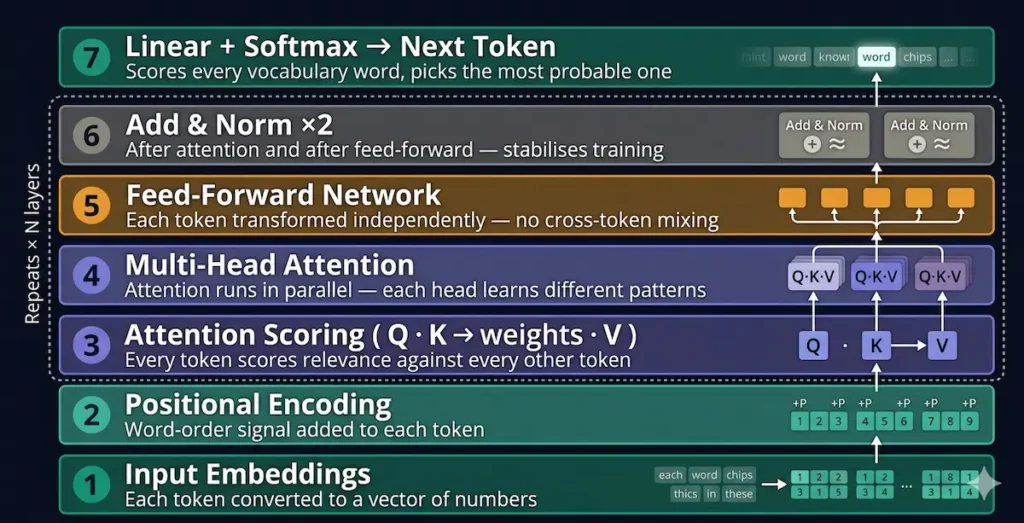
Step ①: Input Embeddings
Computers don’t understand words. They only understand numbers. So the first step is converting every word into a list of numbers called an embedding.
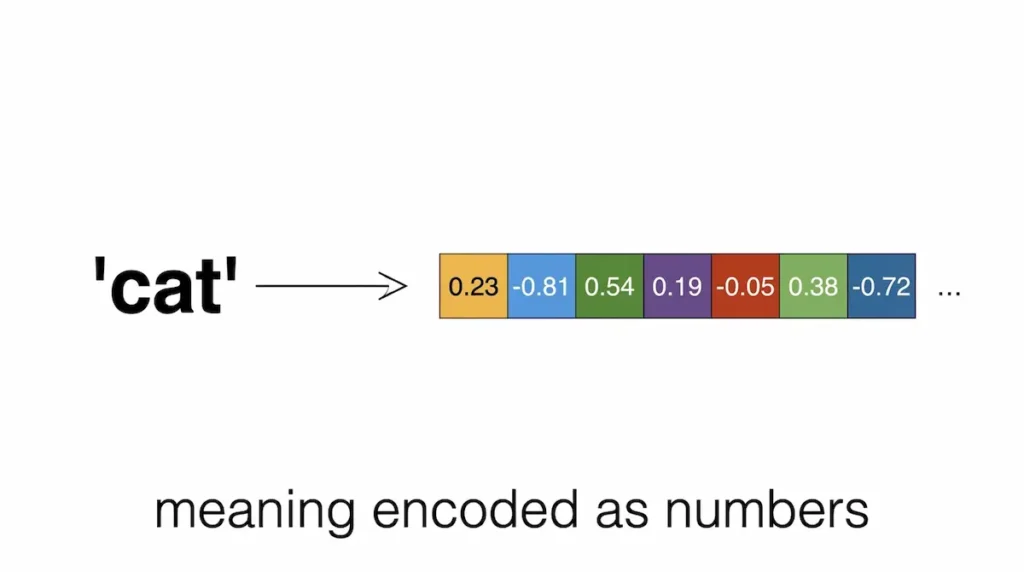
These numbers are not random. They are learned during training so that words with similar meanings end up with similar numbers. After training, “king” and “queen” will have vectors that sit close together. And the words like “Pizza” and “democracy” will be far apart.
A typical embedding vector might be 512, 768, or even 4,096 numbers long, depending on the model. Each number represents one small aspect of the word’s meaning. Together, they act as a precise address in a mathematical space where meaning is encoded as distance.
Modern transformers do not always embed whole words. They use tokenization, breaking text into smaller chunks. As an example, the word “running” might become two tokens: “run” and “ning.” Each token gets its own embedding. This helps models handle unusual words, typos, and new terms they may not have seen before.
Step ②: Positional Encoding: Where Words Sit
Here is a problem. If the transformer processes all words at the same time, how does it know their order?
“Dog bites man” and “Man bites dog” use the same three words but mean completely different things.
Positional encoding solves this. Before the word vectors enter the rest of the model, a small pattern of numbers is added to each one based on its position in the sentence. Word at position 1 gets a slightly different signal added than word at position 2, position 3, and so on.
The model learns to read these positional signals and use them to understand word order, even while processing everything in parallel.
Step ③: The Attention Mechanism: The Magic Layer Attention Scoring — Q, K, and V
This is where real intelligence begins. The attention mechanism lets every word look at every other word and decide: how important is that word to understanding me?
Take the sentence: “The trophy didn’t fit in the suitcase because it was too big.”
What does “it” refer to? The trophy or the suitcase? As a human, you reason backwards and figure out “it” must be the trophy — because the trophy is what was too big to fit.
The attention mechanism does the same thing. For the word “it,” it calculates an attention score between “it” and every other word in the sentence. The word “trophy” will get a high score; the word “because” will get a low score.
These scores are then used to build a new, richer version of each word — one that bakes in context from all the relevant words around it.
The scores are calculated using three vectors per word, called Query (Q), Key (K), and Value (V).
- The Query is what the current word is “asking” — what context do I need?
- The Keys are what each other word “offers” — here’s what I’m about
- The Values are the actual information those words carry
The model multiplies Q by K for each pair, scales the result, passes it through a softmax function (which turns scores into percentages that add up to 100%), then uses those percentages to take a weighted sum of the Values.
You don’t need to memorise that formula. The key point is: attention lets every word selectively borrow context from every other word.
[Learn more about: Attention Mechanism Explained Visually]
Step ④: Multi-Head Attention
One round of Q·K·V scoring is called a single attention head.
The transformer does not stop at one. It runs the attention scoring process several times in parallel, typically 8, 12, or 16 times each time using different learned parameters. This is multi-head attention.
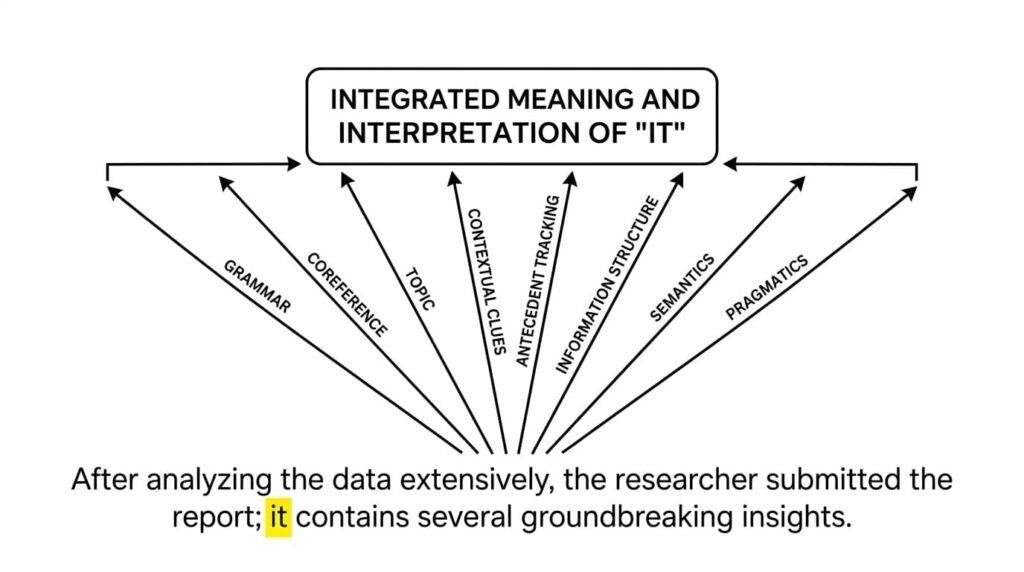
Each head learns to pay attention to different things. One head might focus on grammatical relationships, which word is the subject, which is the object. Another might track pronoun references. Another might link topic-related words across a long passage.
All the heads run at the same time. Their results are then combined into a single output that is richer than any single head could produce alone.
Think of it like having eight editors review the same paragraph simultaneously, each reading for a different thing such as grammar, tone, logic, consistency and then pooling their notes.
Let’s take the example show in image below, here multiple interpretation of “it” were created simultaneously to get the most complete, context-aware understanding possible
Step ⑤: Feed-Forward Network: The Thinking Layer
After the attention layer, each word’s representation passes through a feed-forward network (FFN).
Think of the attention layer as a “gathering information” step—each word collects context from its neighbors. The FFN is the “thinking” step—each word processes that gathered information independently.
The FFN applies two mathematical transformations in sequence, with a non-linear activation between them. In plain language: it mixes and reshapes the numbers in ways the model has learned are useful for predicting language.
One important detail: the FFN works on each token completely independently. There is no cross-token communication here at all. Word 1 is processed on its own, Word 2 is processed on its own, and so on. All cross-word communication happened in the attention step; the FFN is purely per-token processing.
This separation of attention for context-gathering and FFN for per-token reasoning is one of the key design choices that make transformers work so well.
Step ⑥: Add & Norm: Keeping Everything Stable, Appears Twice Per Layer
After both the attention step and the FFN step, the transformer adds two stabilizing components:
- First time: immediately after multi-head attention (step ④).
- Second time: immediately after the feed-forward network (step ⑤).
Each time it does two things:
Add (residual connection): The output of each sub-layer is added back to its own input before it was processed. This gives the model a direct “shortcut” path — information can skip the transformation entirely and flow straight through. This prevents information loss in deep networks and makes training far more stable.
Norm (layer normalization): The numbers flowing through the network are rescaled to stay in a healthy range. Without this, numbers can grow enormously or shrink to near-zero as they pass through many layers. Either way, learning breaks down. Layer norm keeps everything in check.
Together, Add & Norm act as a stabilizer. They are the reason transformers can be stacked dozens or hundreds of layers deep without falling apart during training.
The Repeating Block: How Many Layers being repeated?
Look at the dashed bracket in the diagram. Steps ③ through ⑥ — attention scoring, multi-head attention, feed-forward network, and both Add & Norm steps — form one complete transformer layer. This entire block repeats N times.
A single layer is:
Attention scoring (③) → Multi-head attention (④) → Add & Norm (⑥) → Feed-forward (⑤) → Add & Norm (⑥)
And that full sequence stacks on top of itself again and again.
GPT-2 (a small model by today’s standards) had 12 layers. GPT-3 had 96. The largest models today have hundreds. More layers mean more capacity to learn complex language patterns — but also more compute and memory required.
Each layer takes the output of the previous one as its input, building progressively more abstract and sophisticated representations of the text.
Step ⑦: The Output — Picking the Next Word
After passing through all the layers, the model produces a final vector for the next word position.
This vector is passed through a linear layer, which maps it to a score for every word in the model’s vocabulary — often 50,000 or more words. Then a softmax function converts those scores into probabilities. Every word in the vocabulary gets a probability, and all probabilities add up to 100%.
The model picks the next word, either the highest-probability one, or using a sampling method that introduces a small amount of randomness. This randomness is what makes responses feel natural and varied rather than robotic and repetitive.
Then the whole process repeats for the next word, and the next, and the next — until the model decides to stop.
Encoder vs Decoder: Must to know
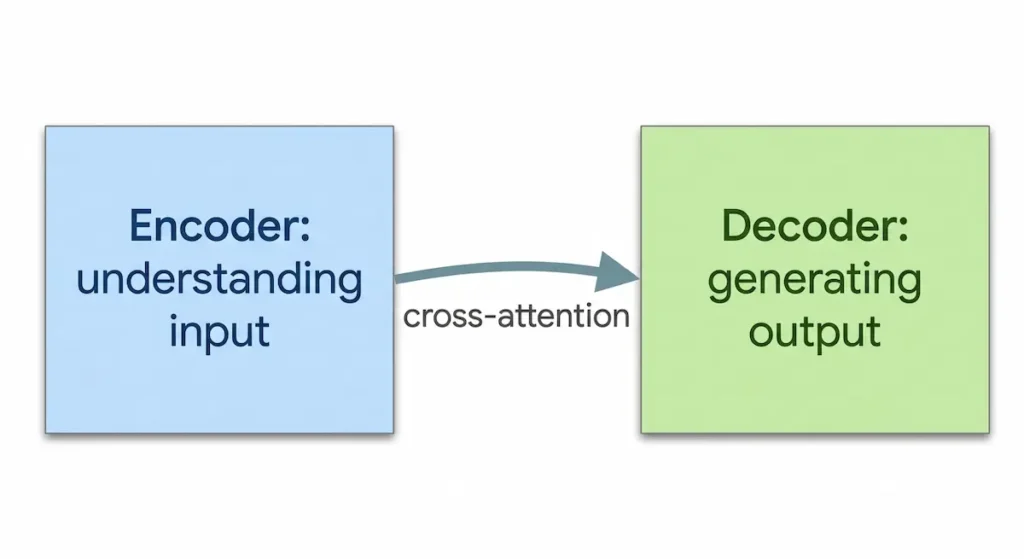
In this post we have used a diagram for simpler explanation. However, the original transformer (as used in translation) has two halves:
The Encoder reads the input text (e.g., a sentence in French). It processes all the input words and builds a rich set of contextual representations. No word generation happens here — it’s pure comprehension.
The Decoder generates the output text (e.g., the English translation), one word at a time. It has two types of attention:
- Masked self-attention — it looks at the words it has already generated, but cannot look ahead at words it hasn’t written yet. (This is the “masked” part — future words are hidden.)
- Cross-attention — it attends to the encoder’s output, letting it “consult” the original input while generating each new word.
Not every modern model uses both halves. Tools like CustomGPT.ai, built on GPT-style models, use only the decoder: generating text without a separate encoding step. Models like BERT use only the encoder: built for classifying and understanding text rather than generating it.
The diagram’s flow represents the universal core. Encoder and decoder are specialized applications of that same core, tailored to different tasks.
Cutting Edge Tools Built on Transformers
Understanding how transformers work helps you use AI tools more effectively and choose the right one for your needs.
CustomGPT.ai — A business-focused AI platform built on GPT-4 transformer architecture. You can train it on your own documents and deploy it as a customer-facing chatbot or internal knowledge tool. A practical choice for businesses wanting the power of transformers without the technical setup.
Rytr — An AI writing assistant built on transformer language models. It generates blog posts, product descriptions, emails, and social media content at speed. A good starting point if you want to see transformers doing creative writing work in a simple, affordable interface.
| Tool | Best for |
| CustomGPT.ai | No Code Custom Knowledge Management and Helpdesk/Customer Support Agent + Documentation Support. |
| Rytr | AI-powered Ultimate writing assistant that helps you create high-quality content in seconds, from catchy emails to compelling blogs. |
Conclusion
The transformer is a carefully designed system with a clear flow: convert words to numbers, encode their positions, let every word attend to every other word through scoring and multi-head attention, transform each token through a feed-forward network, stabilize the whole thing with Add & Norm, and repeat that block dozens of times before finally picking the most probable next word.
Three things to carry with you:
- Attention is how words gather context from each other — all at once, not one at a time.
- The attention block and the feed-forward block together form one layer, and that layer repeats N times — with Add & Norm appearing after each sub-layer, twice per layer.
- Everything you interact with in AI today from writing tools like Rytr to business chatbots like CustomGPT.ai runs on some version of this architecture.
If you want to go deeper, start with Attention Mechanism Explained Visually, it builds directly on what you have learned here.
FAQ’s
What is the transformer architecture in simple terms?
A transformer is a neural network that processes all words in a sentence at the same time, using an “attention” mechanism to figure out how each word relates to every other word. This lets it understand context and meaning far better than older AI models that read text word by word.
Who invented the transformer?
The transformer was introduced in 2017 by a team of researchers at Google Brain in a paper called “Attention Is All You Need.” The team included Ashish Vaswani, Noam Shazeer, and six colleagues.
What is the difference between attention scoring and multi-head attention?
Attention scoring (step ③) is the core calculation — using Q, K, and V vectors to decide how much each token should borrow from every other token. Multi-head attention (step ④) runs that same scoring process multiple times in parallel, with each run learning to focus on a different type of relationship in the text. The results are combined into a single richer output.
Why does Add & Norm appear twice in each transformer layer?
Because there are two sub-layers in every transformer layer — the attention block and the feed-forward block — and each one needs its own stabilisation step immediately after it. Skipping either one would make training unstable in deep networks.
Is GPT a transformer model?
Yes. GPT stands for Generative Pre-trained Transformer. It uses the decoder-only variant of the transformer architecture. The same applies to the models powering CustomeGPT.ai, Claude, Gemini, Llama, and most other large language models today.
What’s the role of feed-forward network in transformer?
It processes each token independently after the attention step. Where attention gathers context from across the whole sentence, the feed-forward network applies a learned transformation to each token on its own — no cross-token communication. The two steps together give each token both broad context and deep per-token reasoning.