
- AI Prompts are the instructions you give to Generative AI models (like LLMs and Text-to-Image AI).
- “Prompt Engineering” is the art and science of crafting effective prompts to get desired outputs.
- Key tips include being clear, specific, providing context, and defining the desired format.
- Mastering prompts is crucial for unlocking the full potential of Generative AI and achieving your objectives.
- Good prompts act as guardrails and significantly reduce hallucinations and unwanted outputs.
Table of Contents
Introduction
In today’s world, where we use AI programs like ChatGPT to write and DALL-E to make pictures, it’s really important to know how to talk to these machines properly. What you tell the AI (we call this an “AI Prompt”) directly affects how good its answer or picture will be.
Learning how to write good AI Prompts, also known as “Prompt Engineering,” isn’t just for experts anymore. It’s a useful skill for everyone because it helps you get exactly what you want from these powerful AI tools. It’s like giving clear directions instead of vague ideas, so the AI can understand and achieve your goal.
Core Concepts
AI Prompts are the natural language instructions given to an AI model to guide its output. Prompt Engineering is the discipline of designing these prompts in a way that obtain the best possible response from the AI. It’s about being clear, concise, and comprehensive in your communication with a machine that, despite its intelligence, lacks human intuition and common sense.
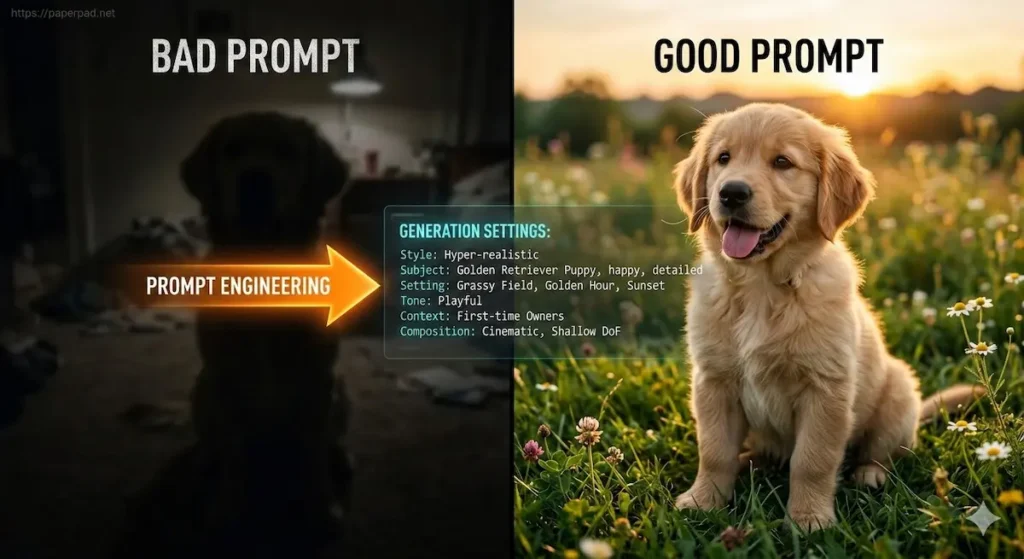
Here are 7 Powerful Tips to Master Prompt Engineering:
- Be Clear and Specific (Avoid Ambiguity1):
- Concept: Don’t assume the AI understands your unspoken intentions. State exactly what you want. Ambiguity leads to unpredictable or irrelevant outputs.
- Why it works: AI operates on statistical patterns2. Clear instructions narrow down the possibilities, reducing the chance of hallucinations3 or off-topic responses.
- Example (Bad): “Write about dogs.” (Too broad)
- Example (Good): “Write a 200-word blog post about the benefits of owning a Golden Retriever for first-time pet owners, focusing on their friendly nature and trainability4.”
- Provide Context and Background Information:
- Concept: Give the AI enough background knowledge to understand the situation, purpose, and audience for its output.
- Why it works: Context is crucial for AI to generate relevant and appropriate responses. It helps the model “ground” its output in your specific scenario.
- Example (Bad): “Write a presentation.”
- Example (Good): “Write a 10-slide presentation for a marketing team meeting. The topic is ‘Q3 Performance Review.’ Audience: Marketing VPs. Objective: Highlight successes, analyze challenges, and propose strategies for Q4.”
- Define the Desired Format and Structure:
- Concept: Specify how you want the output organized. Do you need a list, a paragraph, a table, code, a specific image aspect ratio?
- Why it works: AI can adapt its output style. Providing a clear structure acts as a guardrail, ensuring the output is immediately usable and meets your requirements.
- Example (Bad): “Give me facts about space.”
- Example (Good): “List 5 facts about the Golden Retriever5 in bullet points, each fact no longer than one sentence.”
- Specify the Tone, Style, and Persona:
- Concept: Instruct the AI on the voice it should adopt and the style of writing. Should it be formal, casual, humorous, academic, persuasive?
- Why it works: AI can mimic various writing styles. This helps tailor the output to your target audience and objective.
- Example (Bad): “Write a story.”
- Example (Good): “Write a short, playful children’s story (ages 4-6) about a mischievous squirrel who tries to hide acorns6 from a friendly bear. Use simple vocabulary and a playful tone.”
- Give Examples (Few-Shot Prompting):
- Concept: If possible, provide one or more examples of the desired input-output format. This is particularly effective for complex or nuanced7 tasks.
- Why it works: AI learns from examples. Showing it exactly what you want dramatically improves the chances of getting a similar, high-quality output. This is a powerful tool for guiding the AI.
- Example (Bad): “Translate this into corporate jargon.”
- Example (Good): “Translate the following into corporate jargon.
- Input: ‘Let’s meet to discuss.’ Output: ‘Let’s synergize on this.’
- Input: ‘We need to fix this problem.’ Output: ‘We need to operationalize a solution to this pain point.’
- Input: ‘The project is late.’ Output: ‘The project timeline requires recalibration.'”
- Iterate and Refine (The Feedback Loop):
- Concept: Prompt engineering is rarely a one-shot process. Start with a basic prompt, evaluate the output, and then refine your prompt based on what you see.
- Why it works: AI provides a feedback loop. By observing its responses, you learn how the AI interprets your instructions, allowing you to adapt and improve your prompts over time.
- Workflow: Prompt -> Observe Output -> Refine Prompt -> Repeat.
- Define Restrictions and Limitations:
- Concept: Tell the AI what not to do, or what specific boundaries it must adhere to (e.g., character limits, specific vocabulary to avoid, ethical guardrails).
- Why it works: This helps prevent unwanted outputs, keeps the AI focused, and is crucial for compliance and safety.
- Example (Good): “Generate 5 headlines for an article about sustainable farming. Each headline must be under 60 characters and avoid using the word ‘green’.”
Mastering these tips transforms your interaction with Generative AI from guesswork to precision engineering, unlocking its full creative and analytical potential.
How It Works
Effective prompt engineering is essentially about clearly defining the AI’s objective, setting its boundaries, and providing sufficient context within its workflow.
- User Input (The Prompt):
- You, the user, craft your instructions using natural language, incorporating the tips above.
- Prompt Encoding (AI’s Interpretation):
- The AI model (e.g., an LLM‘s Transformer architecture) processes your prompt, converting it into a numerical representation (embedding) that captures its meaning, context, and intentions. The clarity of your prompt directly impacts the accuracy of this encoding.
- Inference8 & Generation:
- Based on its vast training data and the encoded prompt, the AI performs inference. It predicts the most statistically probable sequence of words, pixels, or other data points that fulfill your instructions.
- Output:
- The AI delivers its generated content (text, image, code, etc.).
- User Evaluation & Refinement (Feedback Loop):
- You review the output. If it’s not quite right, you use the feedback loop to refine your prompt, adding more detail, clarifying ambiguities, or adjusting constraints. This iterative process is key to achieving your desired objective.
This workflow highlights that prompt engineering is a continuous dialogue, not a one-time command.
Prompt Examples
Effective prompts are the secret behind many successful Generative AI applications.
- Generating Marketing Copy (LLMs):
- Objective: Create a catchy social media post for a new product launch.
- Prompt (Good): “Write three engaging Instagram captions for a new vegan protein bar called ‘Power-Plant.’ Highlight its key benefits: high protein, delicious berry flavor, and sustainable ingredients. Include relevant emojis and hashtags. Target audience: fitness enthusiasts aged 25-40. Tone: energetic and inspiring.”
- Why it works: Specifies number of captions, product name, key benefits, target audience, tone, and format (constraints). This significantly improves the quality and relevance of the output compared to a vague request.
- Creating Unique Visuals (Text-to-Image AI):
- Objective: Generate a unique header image for a tech blog post about AI in space.
- Prompt (Good): “A futuristic astronaut helmet made of clear glass, reflecting a cosmic nebula and distant galaxies. The helmet is resting on a rocky, alien planet surface. Style: hyper realistic digital art, intricate details, epic lighting, 16:9 aspect ratio.”
- Why it works: Combines multiple concepts, defines the style, specifies artistic details, and sets an aspect ratio (context, constraints, format). This guides the AI to invent a specific visual.
- Automating Customer Service Responses (LLMs with RAG):
- Objective: Generate a polite and informative response to a customer query about product returns.
- Prompt (Good): “Based on the provided return policy: [Insert full return policy text here]. A customer is asking if they can return a product after 45 days because they were on vacation. Craft a polite email response explaining whether their return is eligible and what steps they need to take, if any. Maintain a helpful and empathetic tone.”
- Why it works: Provides specific context (the return policy via RAG – retrieval-augmented generation), defines the customer’s situation, specifies the desired output (email), and sets the tone. This helps the AI generate an accurate, grounded, and empathetic response.
Benefits, Trade-offs, and Risks
Benefits
- Unlocks AI Potential: Effective prompts are the gateway to fully leveraging the power of Generative AI for diverse tasks.
- Improves Output Quality: Leads to more accurate, relevant, and higher-quality results, reducing hallucinations.
- Enhances Efficiency: Reduces the time and effort needed to get desired outputs, accelerating workflows.
- Fosters Creativity: Allows users to explore a wider range of ideas and iterations, driving creative exploration.
- Democratizes AI: Makes complex AI models more accessible and usable by anyone with strong communication skills.
Trade-offs/Limitations
- Learning Curve: Mastering prompt engineering takes practice and understanding of AI’s capabilities and constraints.
- AI Interpretation: Even with good prompts, AI’s probabilistic nature means outputs can sometimes be unpredictable or require further refinement.
- Context Window Limits: LLMs have a limited “context window” (the amount of text they can process at once), which can be a constraint for very long prompts or complex interactions.
- Over-reliance: Over-reliance on AI without critical human review (lack of human-in-the-loop) can lead to errors even with good prompts.
Risks & Guardrails
- Bias Amplification: Even well-crafted prompts can lead to biased outputs if the underlying model was trained on biased data. Constant vigilance and guardrails are needed.
- Misinformation Generation: If the prompt asks for factual information, the AI might hallucinate plausible but incorrect details. Always verify critical information.
- Prompt Injection Attacks: Malicious users might craft prompts to bypass guardrails or extract sensitive information, posing a security risk.
- Ethical Concerns: Prompts can be used to generate harmful or unethical content if not guided by strict guardrails.
- Guardrail: Implement human-in-the-loop review for critical outputs, use RAG (retrieval-augmented generation) for factual grounding, and continuously refine internal governance and ethical guidelines for prompt usage.
What to Do Next / Practical Guidance
Becoming proficient in prompt engineering is a valuable skill for the AI era.
- Now (Practice the Fundamentals):
- Start Simple, Then Add Detail: Begin with a basic request and gradually add context, format, tone, and constraints as you refine the output.
- Experiment with Keywords: Try different phrasing and keywords to see how the AI responds.
- Use Clear Language: Avoid jargon unless it’s specific to the AI’s domain.
- Metrics to Watch: How many prompts does it take to get a satisfactory output?
- Next (Deepen Your Skills):
- Learn About Model Capabilities: Understand the specific strengths and weaknesses of the Generative AI model you’re using (e.g., an LLM9 vs. a Text-to-Image AI) (click the link Try generating image using text).
- Explore Advanced Techniques: Research “few-shot prompting,” “chain-of-thought prompting,” and other advanced prompt engineering strategies.
- Use Tools: Leverage prompt template libraries or prompt management tools to organize and reuse effective prompts.
- Metrics to Watch: Reduction in prompt length while maintaining output quality, increased diversity of useful outputs.
- Later (Master & Innovate):
- Develop Internal Best Practices: Create prompt engineering guidelines and best practices for your team or organization to ensure consistent and high-quality AI usage.
- Share Knowledge: Contribute to the growing community of prompt engineers, sharing effective techniques and learning from others.
- Integrate into Workflows: Design workflows where prompt engineering is a key skill, making AI a seamless and powerful tool.
- Metrics to Watch: Overall ROI10 from AI-assisted tasks, reduction in time-to-market for creative content, and improved compliance with internal guidelines.
Common Misconceptions
- “Prompt engineering is just typing a question”: It’s a deliberate, iterative process of crafting precise instructions to guide AI behavior.
- “AI will figure out what I want eventually”: While AI is adaptive, explicit instructions greatly improve efficiency and accuracy.
- “Longer prompts are always better”: Not necessarily. Clear, concise, and well-structured prompts are more effective than long, rambling ones.
- “There’s one perfect prompt for everything”: The best prompt depends entirely on the objective, the AI model, and the desired output.
- “Prompt engineering is a passing fad”: As Generative AI becomes more prevalent, the ability to communicate effectively with it will be a foundational skill.
Conclusion
To get the best results from AI, you need to be good at “Prompt Engineering.” This means knowing how to give clear instructions to the AI.
Here’s how to do it:
- Be clear and specific: Don’t be vague; tell the AI exactly what you want.
- Give context: Explain the background or situation.
- Define the format: Tell the AI how you want the answer to look (e.g., a list, a paragraph).
- Improve over time: Don’t be afraid to try different prompts until you get what you need.
By doing these things, you can turn your general ideas into exact commands for AI programs like ChatGPT or DALL-E. This skill is more than just typing; it’s about smart communication. It helps the AI stay on track, prevents it from making up false information (called “hallucinations”), and guides it to do what you want.
As AI keeps getting better, knowing how to write good prompts will be essential for using these powerful tools effectively and responsibly.
- The quality of being open to more than one interpretation. ↩︎
- Recurring trends, relationships, or regularities observed within data. ↩︎
- An experience involving the apparent perception of something not present. ↩︎
- The capacity of an individual (human, animal, or system) to learn, adapt, and improve skills through instruction, practice, or experience. ↩︎
- The Golden Retriever is a Scottish breed of retriever dog of medium-large size. ↩︎
- The fruit of the oak tree. ↩︎
- A subtle difference in or shade of meaning, expression, or sound. ↩︎
- A conclusion reached on the basis of evidence and reasoning. ↩︎
- Large Language Model. ↩︎
- Return on Investment. ↩︎