Skip to content
White "paperpad" text in a casual Caveat handwritten font on a solid black background.
  • About Us
  • Learning Hub
    • AI Basics & Core Concepts
    • Deep Dive into Generative AI
  • Contact Us
  • About Us
  • Learning Hub
    • AI Basics & Core Concepts
    • Deep Dive into Generative AI
  • Contact Us
Linkedin X-twitter
White "paperpad" text in a casual Caveat handwritten font on a solid black background.
  • About Us
  • Learning Hub
    • AI Basics & Core Concepts
    • Deep Dive into Generative AI
  • Contact Us
Linkedin X-twitter
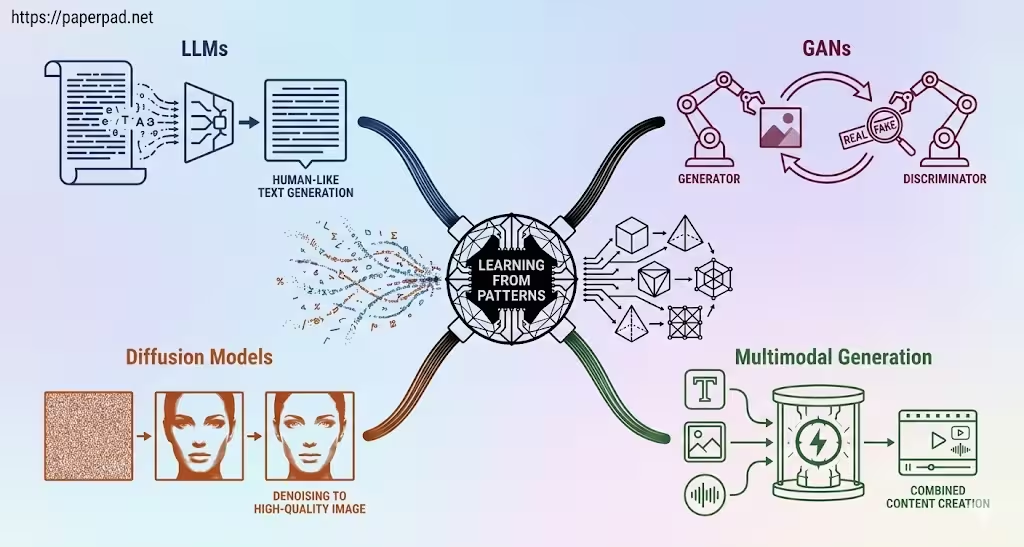
Generative AI infographic: LLMs, GANs, Diffusion, and Multimodal models on light gradient background with paperpad.net watermark.
AI Creation

Generative AI: 5 Top Ways AI Creates New Content

Generative AI Explained: Explore 5 powerful ways AI creates new content, from LLMs to GANs and Diffusion Models. Understand how

Read More »
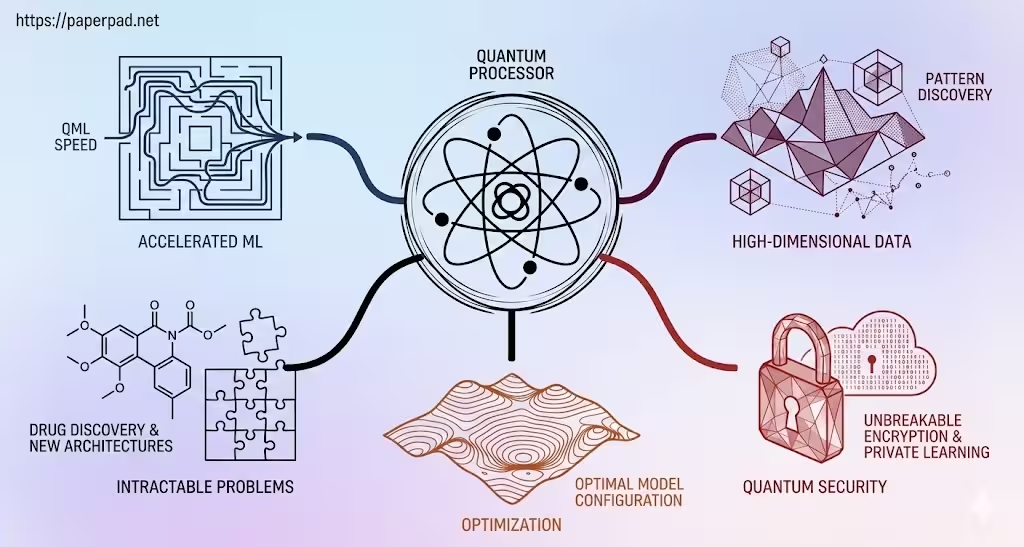
Quantum computing AI infographic: Central processor node connecting to ML, data, security, and optimization modules on a light gradient.
AI

Quantum Computing & AI: 5 Powerful Reasons for a Future Partnership

Quantum Computing & AI: Explore 5 powerful reasons why this future partnership could revolutionize AI. Understand how quantum computing can
Read More »
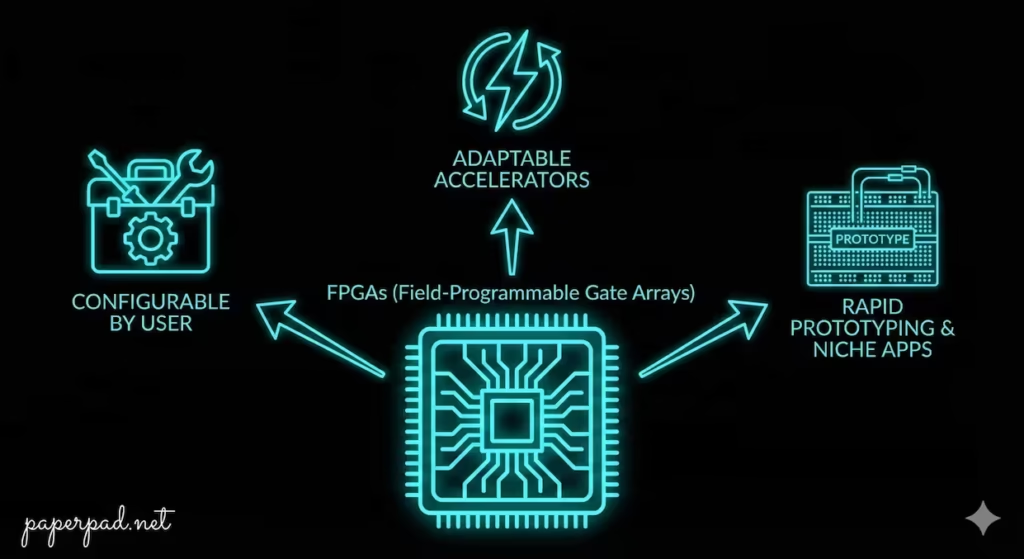
AI Hardware The FPGA's Role in Adaptability and Rapid Prototyping
AI Hardware

AI Hardware : 5 Powerful Chips Driving the AI

The AI Revolution is fueled by specialized hardware, moving beyond traditional CPUs.

GPUs (Graphics Processing Units) are key, excelling at
Read More »
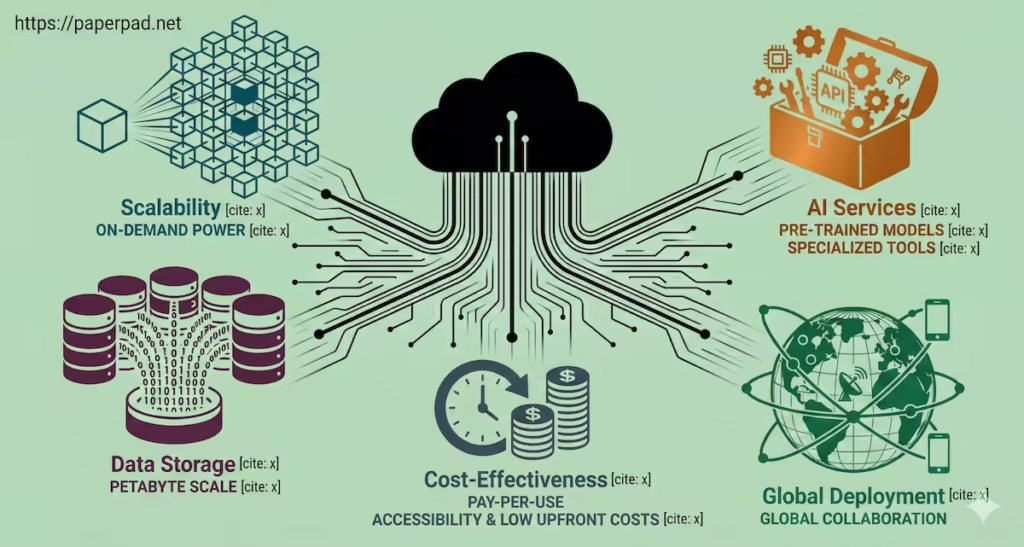
Cloud Computing in AI Cloud AI infographic on a light green background with 5 modules for scalability, services, storage, cost, and deployment.
AI

Cloud Computing in AI: 5 Powerful Ways Cloud Fuels AI’s Growth

Cloud Computing provides the massive computational power and flexible infrastructure essential for modern AI.

It’s crucial for training complex Deep
Read More »
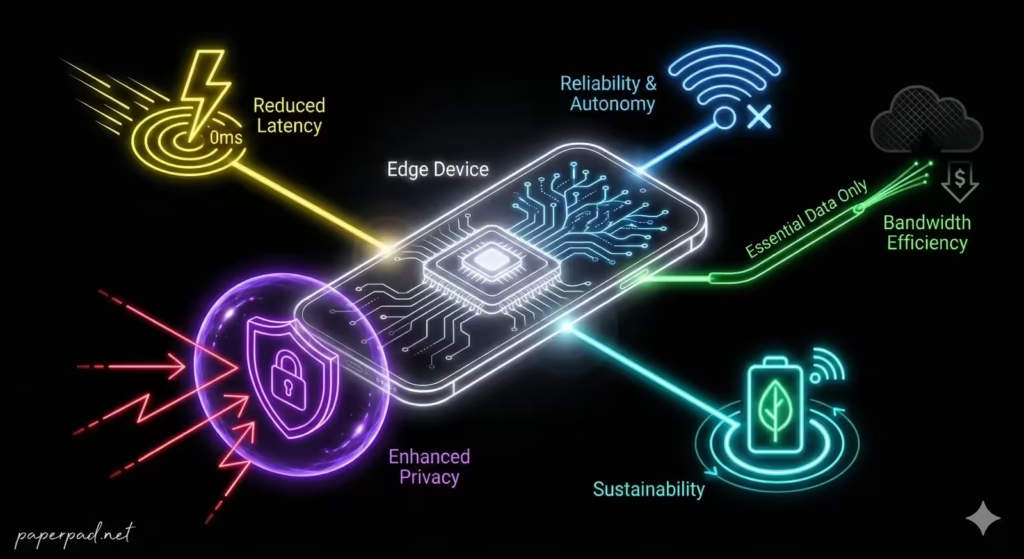
Infographic of Edge AI benefits: latency, reliability, efficiency, sustainability, and privacy on a sage green background.
AI Applications

What is Edge AI: 5 Powerful Reasons AI Moves to the Source

Edge AI means running AI processing directly on local devices (“the edge”) rather than in a central cloud server.

It’s
Read More »
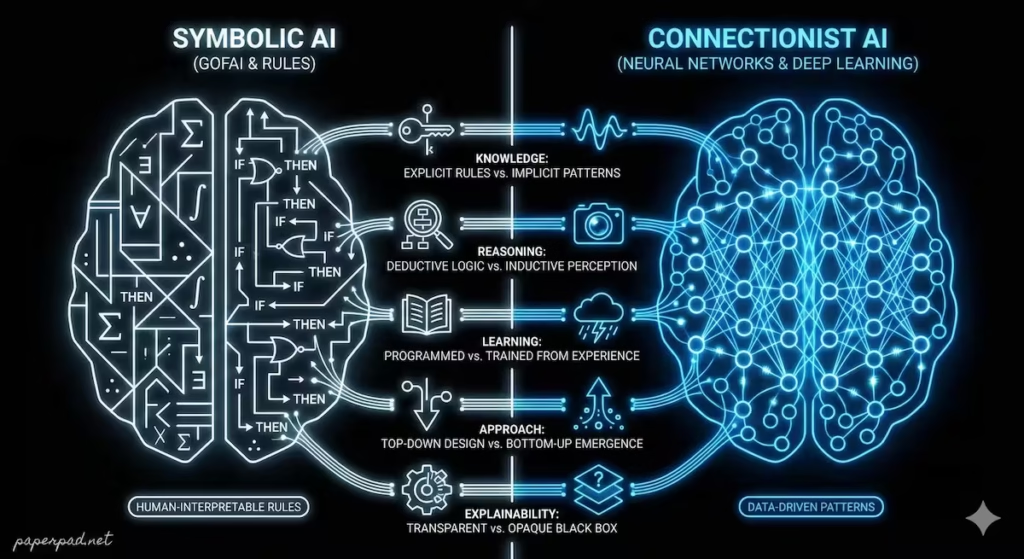
A brain split to compare 'SYMBOLIC AI (GOFAI & RULES)' and 'HUMAN-INTERPRETABLE RULES' (IF-THEN, logic gates) on the left vs. 'CONNECTIONIST AI (NEURAL NETWORKS & DEEP LEARNING)' and 'DATA-DRIVEN PATTERNS' (interconnected neural network) on the right. Five central comparison categories: KNOWLEDGE (Explicit Rules vs Implicit Patterns), REASONING (Deductive Logic vs Inductive Perception), LEARNING (Programmed vs Trained from Experience), APPROACH (Top-Down Design vs Bottom-Up Emergence), and EXPLAINABILITY (Transparent vs Opaque Black Box). 'paperpad.net' is at the bottom left.
AI Paths

Symbolic AI vs Connectionist AI

Symbolic AI uses explicit rules and symbols to represent knowledge, like a detailed instruction manual.

Connectionist AI (like neural networks)
Read More »
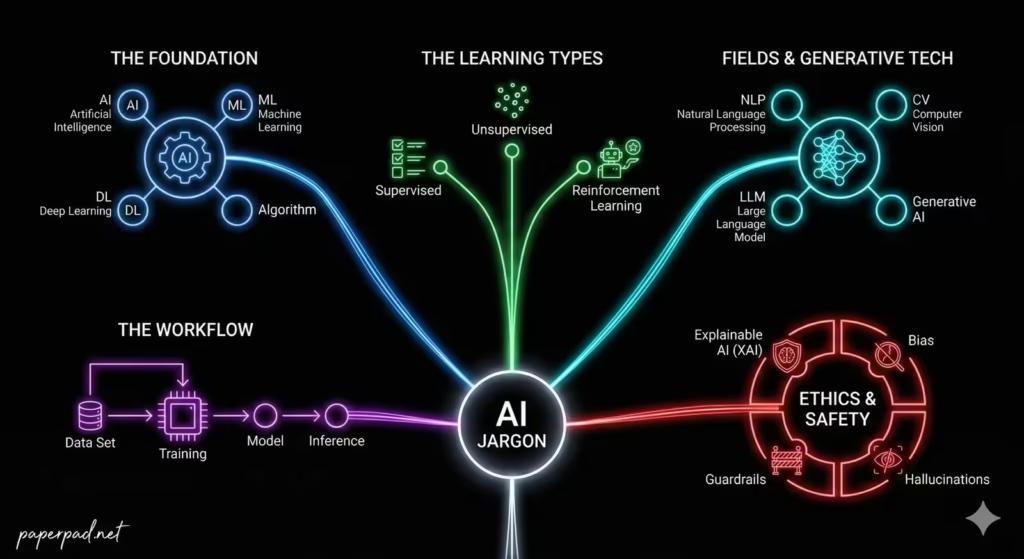
"infographic titled AI terminology: A Visual Map of the Artificial Intelligence Landscape' by paperpad.net. The design features a central 'AI JARGON' node with five branching categories shown in a neon-style aesthetic: The Foundation: Connecting AI, Machine Learning, Deep Learning, and Algorithm. The Learning Types: Featuring Supervised, Unsupervised, and Reinforcement Learning. Fields & Generative Tech: Highlighting NLP, Computer Vision, Large Language Models (LLM), and Generative AI. The Workflow: Illustrating the process flow from Data Set through Training, Model, and Inference. Ethics & Safety: Including Explainable AI (XAI), Bias, Guardrails, and Hallucinations."
AI Glossary

AI terminology Easy to understand

AI terminology can be intimidating, but understanding key terms demystifies the field.
This glossary provides simple, clear explanations for
Read More »
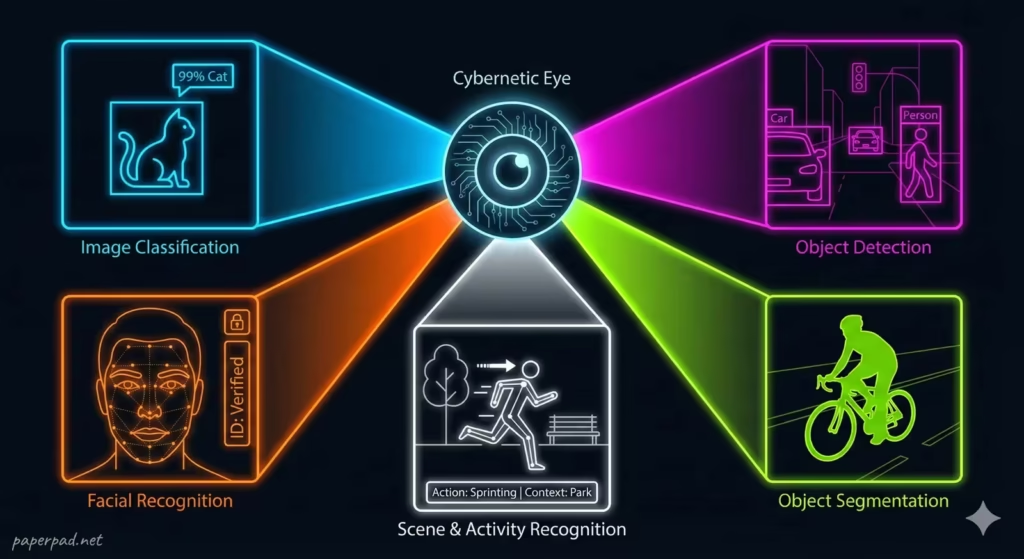
"Infographic titled 'Digital Sight: 5 Ways Computer Vision Interprets Our World' by paperpad.net. The graphic features a central 'Cybernetic Eye' icon radiating five beams, each highlighting a specific computer vision task in a neon aesthetic: Image Classification: A box highlighting a cat with a '99% Cat' label. Object Detection: A street scene identifying a 'Car' and a 'Person' with bounding boxes. Facial Recognition: A digital scan of a face showing an 'ID: Verified' status. Scene & Activity Recognition: A graphic showing a person running in a park with labels 'Action: Sprinting' and 'Context: Park'. Object Segmentation: An outlined silhouette of a person riding a bicycle."
AI

Computer Vision: 5 Powerful Ways AI Sees the World

Computer Vision is the field of AI that enables computers to “see,” interpret, and understand visual information from images and
Read More »
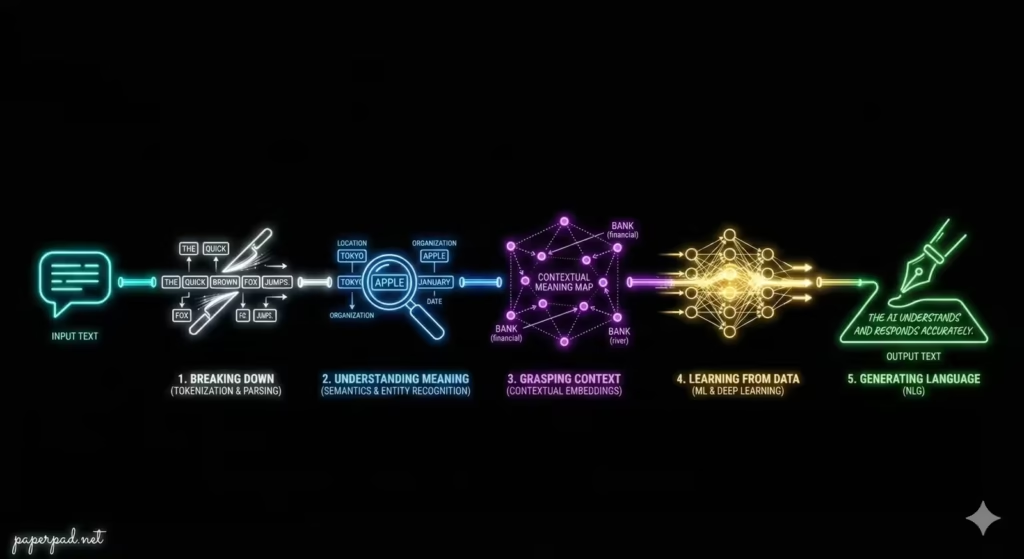
"Infographic titled 'The 5 Stages of Natural Language Processing: Teaching Machines to Speak Human' by paperpad.net. The graphic illustrates a 5-step process in a neon-style flow chart: 1. Breaking Down (Tokenization & Parsing): Represented by text blocks being separated. 2. Understanding Meaning (Semantics & Entity Recognition): Depicted with a magnifying glass focusing on text entities. 3. Grasping Context (Contextual Embeddings): Shown as a network map of interconnected meanings. 4. Learning From Data (ML & Deep Learning): Represented by a glowing neural network structure. 5. Generating Language (NLG): Signified by an icon of a fountain pen writing, representing accurate AI response."
AI

Natural Language Processing (NLP): 5 Best Ways Teaching Computers

Natural Language Processing (NLP) is the field of AI that enables computers to understand, interpret, and generate human language.

It
Read More »
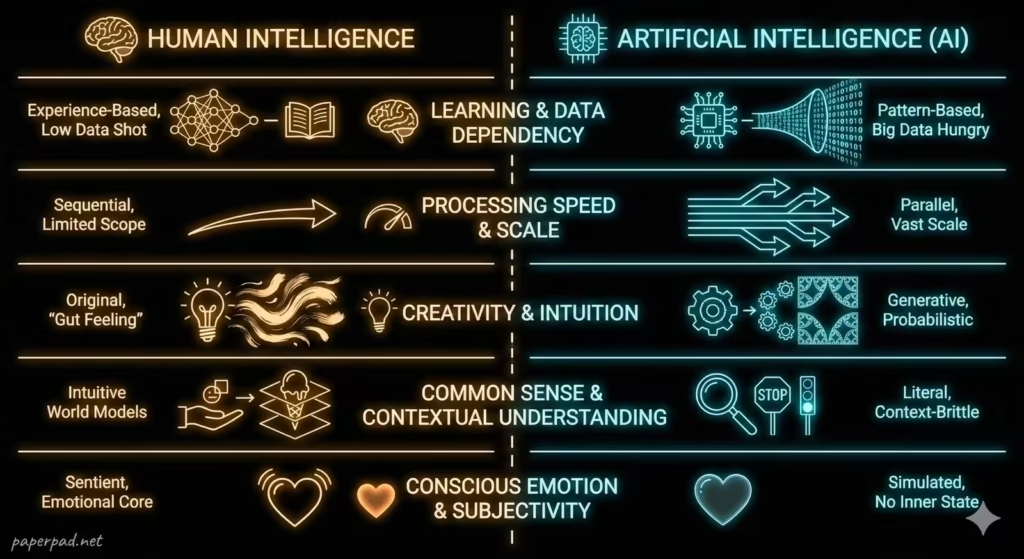
"Infographic titled 'Human Intelligence vs. Artificial Intelligence: The 5 Fundamental Gaps' by paperpad.net. The graphic presents a side-by-side comparison of AI vs human intelligence across five key areas, using a neon-style aesthetic: Learning & Data Dependency: Contrasts human 'Experience-Based, Low Data Shot' learning against AI’s 'Pattern-Based, Big Data Hungry' approach. Processing Speed & Scale: Compares human 'Sequential, Limited Scope' processing with AI’s 'Parallel, Vast Scale' capabilities. Creativity & Intuition: Differentiates between human 'Original, Gut Feeling' creativity and AI’s 'Generative, Probabilistic' output. Common Sense & Contextual Understanding: Contrasts human 'Intuitive World Models' with AI’s 'Literal, Context-Brittle' nature. Conscious Emotion & Subjectivity: Highlights the difference between the human 'Sentient, Emotional Core' and AI’s 'Simulated, No Inner State'."
AI Limitations

AI vs Human Intelligence: 5 Big Differences Explained

AI vs. Human Intelligence highlights fundamental differences in how each thinks, learns, and operates.

AI excels at speed, data processing,
Read More »
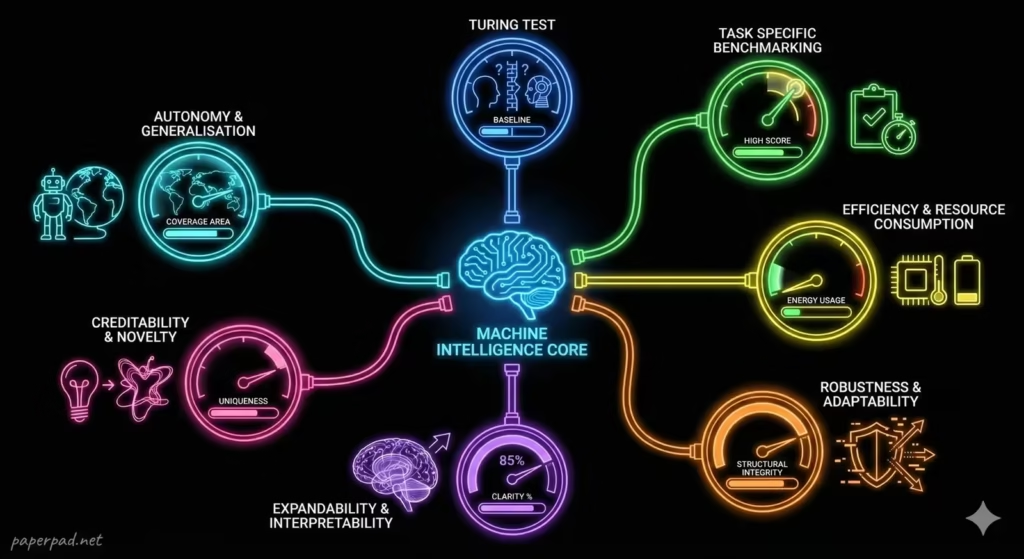
"Measuring AI Intelligence 'The Multi-Dimensional AI Diagnostic Hub' by paperpad.net. The design features a central 'MACHINE INTELLIGENCE CORE' represented by a brain icon, with six branching gauges that monitor various AI performance metrics in a neon-style aesthetic: Autonomy & Generalisation: A gauge showing 'COVERAGE AREA' next to a robot and globe icon. Turing Test: A gauge marked 'BASELINE' with human and AI icons. Task Specific Benchmarking: A gauge showing 'HIGH SCORE' accompanied by a checklist and stopwatch icon. Efficiency & Resource Consumption: A gauge monitoring 'ENERGY USAGE,' paired with chip, thermometer, and battery icons. Robustness & Adaptability: A gauge measuring 'STRUCTURAL INTEGRITY' next to a shield icon with outward-pointing arrows. Expandability & Interpretability: A gauge displaying 'CLARITY %' alongside an icon of a brain with an arrow. Creditability & Novelty: A gauge measuring 'UNIQUENESS' next to a lightbulb and fractal butterfly icon."
AGI

Measuring AI Intelligence : 7 Ultimate Ways to Test AI

Measuring Machine Intelligence isn’t straightforward; it’s more complex than a simple “IQ test” for AI.

Traditional methods like the Turing

Read More »
Comparison of an opaque Black Box AI cube and a transparent Explainable AI cube with five key value pillars.
AI Bias

Explainable AI (XAI): 5 Reasons Understanding “Why” is Critical

Explainable AI (XAI) helps us understand why an AI makes a particular decision, instead of just knowing what it decided.

Read More »
Bias in AI Infographic illustrating how input data is distorted by seven types of bias (historical, representation, etc.), resulting in jagged, biased AI output on a light background.
AI Bias

Bias in AI: Strong 7 Reasons Fair Data Fuels Fair Algorithms

Bias in AI happens when AI systems make unfair or discriminatory decisions.

It often originates from biased training data, reflecting

Read More »
Five colored pillars representing AI ethics (Fairness, Transparency, Human-Centricity, Privacy, Safety) on a light blue background.
AI Accountability

AI Ethics: 5 Pillars for Responsible AI

AI Ethics is about building AI systems that are fair, transparent, and beneficial for humanity.

It’s crucial because AI impacts

Read More »
Infographic showing 4 stages of data flow: ingestion, integration, projection, and validated output on a light gradient. AI Algorithm
AI Explained

AI Algorithm Explained: 4 Best Recipes that Empowers AI.

Discover how AI Algorithms power AI decisions, from basic functions to complex Machine Learning. Understand their role, benefits, and risks.

Read More »
Page1 Page2
  • About Us
  • Learning Hub
    • AI Basics & Core Concepts
    • Deep Dive into Generative AI
  • Contact Us
  • About Us
  • Learning Hub
    • AI Basics & Core Concepts
    • Deep Dive into Generative AI
  • Contact Us
  • Privacy Policy
  • Terms and Conditions
  • Refund and Cancellation Policy
  • Affiliate Disclosure Policy
  • Cookie Policy
  • Disclaimer
  • Privacy Policy
  • Terms and Conditions
  • Refund and Cancellation Policy
  • Affiliate Disclosure Policy
  • Cookie Policy
  • Disclaimer

© 2026 All rights Reserved. Design by Paperpad

Linkedin X-twitter
PaperPad uses cookies to enhance site performance, personalize content, and analyze traffic. By clicking “Accept”, you agree to our Cookie Policy.