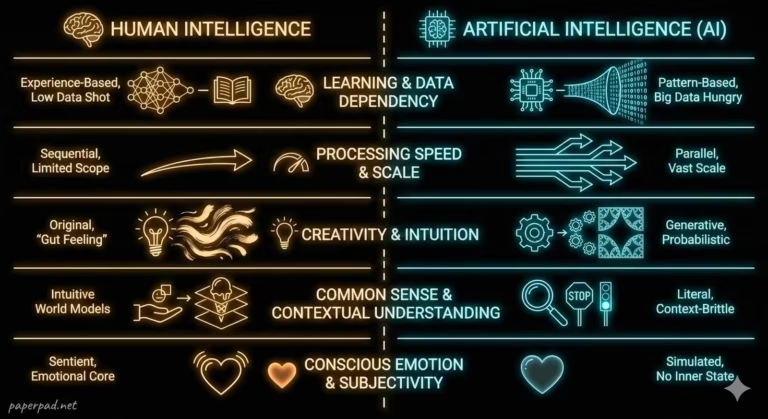
AI vs Human Intelligence: 5 Big Differences Explained

"Infographic titled 'Human Intelligence vs. Artificial Intelligence: The 5 Fundamental Gaps' by paperpad.net. The graphic presents a side-by-side comparison of AI vs human intelligence across five key areas, using a neon-style aesthetic: Learning & Data Dependency: Contrasts human 'Experience-Based, Low Data Shot' learning against AI’s 'Pattern-Based, Big Data Hungry' approach. Processing Speed & Scale: Compares human 'Sequential, Limited Scope' processing with AI’s 'Parallel, Vast Scale' capabilities. Creativity & Intuition: Differentiates between human 'Original, Gut Feeling' creativity and AI’s 'Generative, Probabilistic' output. Common Sense & Contextual Understanding: Contrasts human 'Intuitive World Models' with AI’s 'Literal, Context-Brittle' nature. Conscious Emotion & Subjectivity: Highlights the difference between the human 'Sentient, Emotional Core' and AI’s 'Simulated, No Inner State'."
AI vs. Human Intelligence highlights fundamental differences in how each thinks, learns, and operates. AI excels at speed, data processing, and repetitive tasks, following precise algorithms. Human intelligence shines in creativity, common sense, emotional understanding, and complex context. While AI can mimic aspects of human thought, it lacks true consciousness or subjective experience. Understanding these differences is crucial for effective human-AI collaboration and responsible AI adoption.

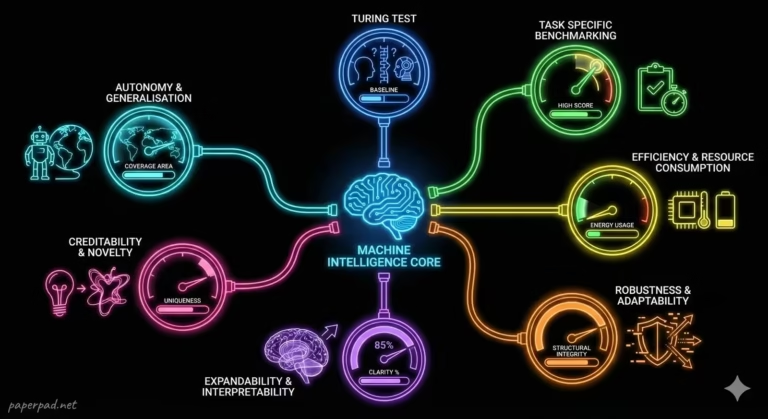
Measuring AI Intelligence : 7 Ultimate Ways to Test AI

"Measuring AI Intelligence 'The Multi-Dimensional AI Diagnostic Hub' by paperpad.net. The design features a central 'MACHINE INTELLIGENCE CORE' represented by a brain icon, with six branching gauges that monitor various AI performance metrics in a neon-style aesthetic: Autonomy & Generalisation: A gauge showing 'COVERAGE AREA' next to a robot and globe icon. Turing Test: A gauge marked 'BASELINE' with human and AI icons. Task Specific Benchmarking: A gauge showing 'HIGH SCORE' accompanied by a checklist and stopwatch icon. Efficiency & Resource Consumption: A gauge monitoring 'ENERGY USAGE,' paired with chip, thermometer, and battery icons. Robustness & Adaptability: A gauge measuring 'STRUCTURAL INTEGRITY' next to a shield icon with outward-pointing arrows. Expandability & Interpretability: A gauge displaying 'CLARITY %' alongside an icon of a brain with an arrow. Creditability & Novelty: A gauge measuring 'UNIQUENESS' next to a lightbulb and fractal butterfly icon."
Measuring Machine Intelligence isn't straightforward; it's more complex than a simple "IQ test" for AI. Traditional methods like the Turing Test focus on human-like conversation, but often fall short. Modern approaches use diverse benchmarking tasks, evaluating AI's abilities in specific domains. Key metrics include performance, efficiency, adaptability, and even creativity. Understanding these methods is crucial for assessing true AI progress and its autonomy.

Explainable AI (XAI): 5 Reasons Understanding “Why” is Critical

Comparison of an opaque Black Box AI cube and a transparent Explainable AI cube with five key value pillars.
Explainable AI (XAI) helps us understand why an AI makes a particular decision, instead of just knowing what it decided. Many powerful AI models are "black boxes," making decisions without clear reasoning. Understanding the "why" is critical for building trust, detecting bias, ensuring safety, and meeting compliance. XAI methods allow us to peek inside these black boxes, providing transparency and auditability. Embracing XAI is vital for responsible AI adoption and effective governance.

Bias in AI: Strong 7 Reasons Fair Data Fuels Fair Algorithms

Bias in AI Infographic illustrating how input data is distorted by seven types of bias (historical, representation, etc.), resulting in jagged, biased AI output on a light background.
Bias in AI happens when AI systems make unfair or discriminatory decisions. It often originates from biased training data, reflecting societal prejudices or historical inequalities. Fair data is crucial because AI algorithms learn from what they're fed; biased data leads to biased outcomes. Recognizing and mitigating bias requires careful data governance, diverse teams, and continuous monitoring. Addressing bias is essential for building trustworthy AI, ensuring ethical compliance, and achieving equitable societal impact.

AI Ethics: 5 Pillars for Responsible AI

Five colored pillars representing AI ethics (Fairness, Transparency, Human-Centricity, Privacy, Safety) on a light blue background.
AI Ethics is about building AI systems that are fair, transparent, and beneficial for humanity. It's crucial because AI impacts everyone, from individual privacy to societal fairness. The 5 pillars include fairness, transparency, accountability, privacy, and safety/reliability. Implementing ethical guardrails involves proactive design, continuous monitoring, and human-in-the-loop oversight. Addressing AI ethics ensures public trust, reduces risks like bias and misuse, and promotes responsible AI adoption.
Unlock Instant Discounts