

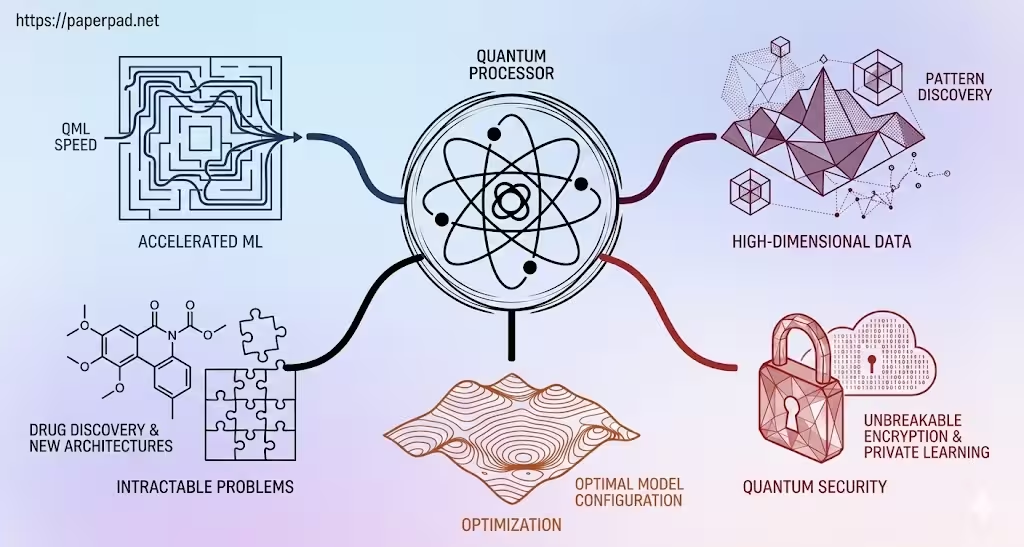
- Quantum Computing, leverages quantum mechanics to solve problems intractable for classical computers.
- While still in early stages, it holds immense potential to revolutionize Artificial Intelligence (AI).
- This “future partnership” could dramatically accelerate Machine Learning algorithms and data analysis.
- Key areas of impact include optimizing complex AI models, enhancing data processing, and solving currently impossible problems.
- Understanding Quantum AI is crucial for anticipating the next frontier of computational power and its impact on intelligent systems.
Table of Contents
Introduction
The worlds of Quantum Computing and Artificial Intelligence (AI), while both at the forefront of technological innovation, have largely developed along separate paths. AI, particularly its Deep Learning component, has been revolutionized by classical computing power (like GPUs and TPUs) and vast data sets. The question that excites researchers today is: “What happens when these two forces combine?” The answer suggests a Quantum AI: 5 Powerful Reasons for a Future Partnership that could unlock unprecedented computational capabilities, dramatically accelerating Machine Learning algorithms, optimizing complex AI models, and solving problems currently beyond our reach. Understanding this potential future synergy is critical for anticipating the next frontier of intelligent systems and preparing for its transformative impact across all sectors.
Core Concepts
To understand the potential partnership, let’s first briefly define Quantum Computing and then explore how it could supercharge AI.
What is Quantum Computing (QC)?
- Classical Computing: Stores information as bits, which are either 0 or 1. Operations are performed sequentially.
- Quantum Computing: Stores information as qubits, which can be 0, 1, or both simultaneously (superposition). Qubits can also be “entangled,” meaning their states are linked. These quantum phenomena allow quantum computers to explore many possibilities at once, leading to exponential speedups for certain types of problems.
- Analogy: If a classical computer is like a single light switch that can be either on or off, a quantum computer is like a room full of dimmer switches that can be on, off, or anywhere in between simultaneously, and the state of one switch can instantly affect others.
Why a Future Partnership?
The sheer computational complexity of many AI tasks—especially training large Deep Learning models—pushes classical computers to their limits. Quantum computers, if they scale as expected, could offer exponential speedups for specific parts of these AI workflows.
Here are 5 Powerful Reasons for a Future Partnership between Quantum Computing and AI:
- Accelerated Machine Learning Algorithms (Quantum Machine Learning – QML):
- Definition: Quantum algorithms could speed up core Machine Learning tasks like pattern recognition, optimization, and linear algebra operations that are fundamental to training models. This could dramatically reduce the time and resources needed to train complex AI models.
- Analogy: Imagine trying to find the shortest path through a maze with millions of possible routes. A classical computer tries paths one by one. A quantum computer could explore many paths simultaneously, finding the solution much faster.
- Enhanced Data Processing & Feature Engineering:
- Definition: Quantum algorithms could process and analyze massive, high-dimensional data sets in ways that are intractable for classical computers. This could lead to more effective feature engineering (identifying important data characteristics) and uncover hidden patterns in data that current AI models miss.
- Analogy: A classical computer analyzes data like looking at a 2D map. A quantum computer could analyze it like seeing a multi-dimensional, interconnected landscape, immediately grasping relationships invisible on the 2D map.
- Optimization of Complex AI Models:
- Definition: Training Deep Learning models often involves finding optimal parameters across a vast “landscape” of possibilities. Quantum optimization algorithms (e.g., Quantum Annealing) could efficiently navigate these complex landscapes to find better model configurations or hyperparameter settings, leading to more powerful and efficient AI models.
- Analogy: Tuning a complex musical instrument with hundreds of adjustments. A classical computer might try combinations systematically. A quantum computer could explore many combinations at once to find the perfect harmony.
- Solving Currently Intractable AI Problems:
- Definition: Quantum AI could tackle problems that are currently beyond the reach of even the most powerful classical supercomputers. This includes complex simulations (e.g., drug discovery, materials science) that could feed into AI-driven research, or truly novel AI architectures that leverage quantum phenomena directly.
- Analogy: Solving a puzzle with an infinite number of pieces. Classical computers give up. Quantum computers might find the solution by leveraging quantum parallelism.
- Secure & Private AI (Quantum Cryptography & Federated Learning):
- Definition: While not directly enhancing AI’s “intelligence,” Quantum Computing brings the potential for fundamentally unbreakable quantum cryptography. This could secure AI data sets and AI models against cyber threats, and enable truly private federated learning where models learn from distributed data without ever exposing the raw information.
- Analogy: Imagine encrypting your AI’s data with a lock that is physically impossible to pick, even with a quantum computer. This enhances privacy and security.
This partnership isn’t about quantum computers replacing classical ones entirely, but about them acting as powerful accelerators for specific, computationally intensive AI tasks within a broader workflow.
How It Works
The workflow of Quantum AI is still largely theoretical and experimental, but it envisions quantum computers acting as co-processors for specific, hard-to-solve components of an AI pipeline.
- Classical Preprocessing:
- Data is collected, cleaned, and preprocessed using classical computers (CPUs, GPUs), as this is still their strength.
- Quantum Data Loading:
- Relevant data (or a compressed representation of it) is loaded into the quantum computer’s qubits. This is a current constraint as loading large classical datasets into quantum states is challenging.
- Quantum Algorithm Execution:
- A quantum algorithm (e.g., for pattern recognition, optimization, or linear algebra) is executed on the quantum computer, leveraging superposition and entanglement to perform computations exponentially faster for certain problems.
- Classical Measurement & Post-processing:
- The results of the quantum computation (which are probabilistic) are measured and then post-processed by classical computers to extract meaningful insights.
- Integration into Classical AI Model:
- These quantum-derived insights (e.g., optimized model parameters, enhanced features, faster predictions) are then fed back into the classical AI model or workflow.
- Deployment & Monitoring:
- The AI model, now potentially more powerful due to quantum acceleration, is deployed and monitored using classical computing infrastructure.
This architecture is often referred to as “hybrid quantum-classical computing.”
Real-World Examples (Projections)
While fully realized Quantum AI is still some time away, researchers are actively exploring its potential.
- Faster Drug Discovery with Quantum-Enhanced AI:
- Scenario (Projection): An AI system rapidly designs new drug molecules to combat a novel disease.
- How it could work: Simulating molecular interactions and properties is incredibly complex, quickly overwhelming classical computers. A quantum computer could perform these molecular simulations at an unprecedented scale and speed. The results of these quantum simulations would then be fed into classical Deep Learning models, which could then predict the efficacy and safety of billions of potential drug candidates, dramatically accelerating the drug discovery pipeline. This would effectively solve currently intractable problems in material science and chemistry, directly impacting AI’s ability to innovate.
- Enhanced Financial Fraud Detection:
- Scenario (Projection): An AI system detects subtle, complex patterns of financial fraud in real-time within massive, high-dimensional transaction data.
- How it could work: Classical Machine Learning struggles to find extremely subtle, non-linear correlations in very large and noisy datasets without immense computational power. A quantum computer could process these complex, high-dimensional transaction data more efficiently, identifying previously invisible patterns of fraudulent activity. This quantum-enhanced pattern recognition would then inform a classical AI model, making it more accurate and resilient against sophisticated fraud schemes, reducing financial risk and improving ROI.
- Optimizing Supply Chains with Quantum-Accelerated Reinforcement Learning:
- Scenario (Projection): An AI system dynamically optimizes global supply chains, factoring in real-time disruptions, varying costs, and complex logistics networks.
- How it could work: Optimizing global supply chains involves solving incredibly complex combinatorial problems (e.g., “traveling salesman problem” variants). Reinforcement Learning agents could be trained using quantum optimization algorithms to explore and find optimal routing, inventory, and resource allocation strategies much faster than classical methods. This would allow AI to adapt to unforeseen events (e.g., port closures, extreme weather) with unprecedented speed and efficiency, especially critical for global trade and delivery in emerging markets.
Benefits, Trade-offs, and Risks
Benefits
- Exponential Speedups: For specific problems, quantum AI could offer computational speedups far beyond classical computers, solving previously intractable problems.
- Enhanced Model Performance: Leads to more powerful, accurate, and efficient AI models due to better optimization and data analysis.
- New Discoveries: Unlocks new frontiers in scientific research (e.g., materials science, drug discovery) that can then be leveraged by AI.
- Secure AI: Quantum cryptography could provide a fundamentally new level of security for AI data sets and models.
Trade-offs/Limitations
- Early Stage Technology: Quantum Computing is still in its infancy (“NISQ era” – Noisy Intermediate-Scale Quantum). Current quantum computers are small, prone to errors, and expensive.
- Specialized Problems: Quantum computers are not general-purpose accelerators; they only offer speedups for specific types of problems.
- Integration Complexity: Integrating quantum components into classical AI workflows is technically challenging.
- Data Loading Bottleneck: Efficiently loading large classical data sets into quantum states is a significant constraint.
Risks & Guardrails
- Misinformation & Hype: Overstating current capabilities could lead to unrealistic expectations and an “AI winter” for quantum AI. Responsible communication is key.
- Ethical Concerns: The immense power of quantum-enhanced AI could exacerbate existing ethical issues (e.g., bias detection, privacy invasion) if not governed by strong guardrails.
- Security Threats: Quantum computers could eventually break current classical encryption methods, posing a future security risk to all digital systems, including AI.
- Accessibility & Control: The high cost and specialized nature of quantum computing could lead to a concentration of power, creating new digital divides.
- Guardrail: Proactive research into quantum-safe cryptography, robust ethical frameworks for Quantum AI, and international governance to ensure equitable access and responsible development.
What to Do Next / Practical Guidance
While Quantum AI is a future prospect, it’s wise to keep an eye on its development.
- Now (Learn & Observe):
- Understand the Basics: Familiarize yourself with the fundamental concepts of Quantum Computing and Machine Learning.
- Monitor Progress: Keep an eye on breakthroughs in quantum hardware and quantum algorithms, particularly in areas relevant to AI.
- Identify Potential Overlaps: Consider if any of your current AI problems (e.g., complex optimization, high-dimensional data analysis) might eventually benefit from quantum acceleration.
- Metrics to Watch: Number of stable qubits, error rates, and demonstrations of quantum advantage for specific problems.
- Next (Experiment & Strategize):
- Explore Quantum ML Libraries: Experiment with quantum Machine Learning libraries and simulators on classical computers to understand their workflow and potential.
- Identify “Quantum-Ready” Problems: Pinpoint specific, computationally intensive sub-problems within your AI pipeline that could potentially benefit from quantum speedups.
- Form Partnerships: Consider collaborating with quantum computing experts or academic institutions to explore potential applications.
- Metrics to Watch: ROI of early quantum experiments, potential speedup for specific tasks, and reduction in classical compute cost.
- Later (Integrate & Govern):
- Develop Hybrid Architectures: As quantum hardware matures, integrate quantum co-processors into your AI workflow for specific tasks.
- Quantum-Safe AI: Begin planning for quantum-safe cryptographic solutions to protect your AI data sets and models from future quantum attacks.
- Ethical Oversight: Establish specific ethical guardrails and governance policies for any quantum-enhanced AI systems, addressing the unique risks and constraints.
- Metrics to Watch: Performance improvements from hybrid quantum-classical AI, security posture against quantum threats, and adherence to ethical guidelines.
Common Misconceptions
- “Quantum computers will replace classical computers”: Quantum computers are specialized accelerators for specific problems; they will likely work alongside classical computers in a hybrid architecture.
- “Quantum AI is just around the corner”: While progress is rapid, practical, fault-tolerant quantum computers capable of widespread AI acceleration are still a decade or more away.
- “Quantum computers make AI smarter”: They make AI faster and capable of solving more complex problems; they don’t inherently make the AI “smarter” in a human-like sense.
- “Quantum AI solves all AI problems”: It’s a powerful tool for specific types of computational challenges, not a universal solution for all AI constraints.
- “Quantum AI will be easy to use”: It requires specialized knowledge and new algorithms to leverage its power effectively.
Conclusion
The potential partnership between Quantum Computing & AI represents a thrilling frontier in the pursuit of machine intelligence. By harnessing the unique properties of quantum mechanics, Quantum AI could offer 5 Powerful Reasons for a Future Partnership that could exponentially accelerate Machine Learning algorithms, enhance data processing, optimize complex AI models, and tackle problems currently beyond our computational reach. While still in its nascent stages, understanding this future synergy is crucial for anticipating the next wave of technological transformation. As we navigate the complex workflow of AI development, integrating quantum capabilities into our architecture with careful governance and ethical guardrails promises to unlock unprecedented power and drive AI into realms we can only begin to imagine.