

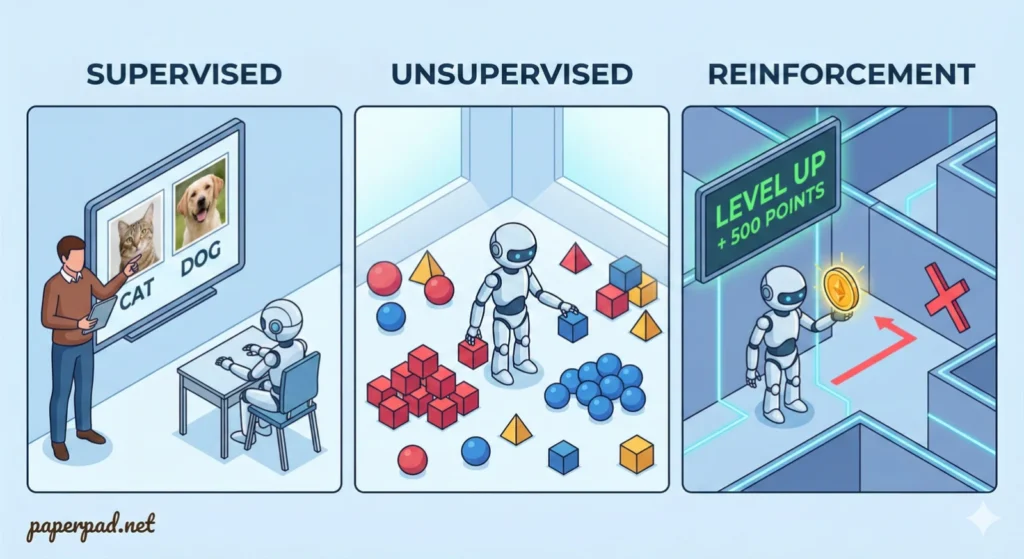
- Supervised Learning teaches AI with labeled examples, like a student with a teacher providing answers.
- Unsupervised Learning lets AI find hidden patterns in unlabeled data, like a student sorting toys without instructions.
- Reinforcement Learning trains AI through trial and error, using rewards and penalties, like teaching a pet tricks.
- Each method has specific objectives, constraints, and best uses, often combined in complex AI systems.
- Understanding these “three ways AI learns” is crucial for building effective and responsible AI.
Table of Contents
Introduction
How does Artificial Intelligence (AI) get so smart? It’s not magic; it learns, much like humans do, but in very specific, systematic ways. When we talk about the “three ways AI learns,” we’re primarily referring to the core paradigms within Machine Learning (ML): Supervised Learning, Unsupervised Learning, and Reinforcement Learning. Each of these methods represents a distinct workflow for how an AI system (often an AI agent) processes information, identifies patterns, and improves its performance. Understanding these different learning styles is fundamental to grasping what AI can and cannot do, and how it’s applied in everything from recommending movies to optimizing complex industrial processes, including those in resource-constrained environments.
Core Concepts
Let’s demystify these fundamental learning approaches:
- 1. Supervised Learning: Learning with a Teacher
- Definition: This is the most common type of Machine Learning. The AI learns from a dataset that has been “labeled,” meaning each piece of input data is paired with the correct output or “answer.” The AI’s objective is to learn the mapping from input to output so it can predict the correct output for new, unseen inputs.
- Analogy: Imagine a student studying for a test. They have a textbook (input data) and an answer key (labels). They learn by looking at the questions, trying to find the answers, and then checking their work against the answer key. The teacher (the labeled data) provides direct feedback on correctness.
- Common Tasks: Classification (predicting categories, e.g., spam/not spam, disease/no disease) and Regression (predicting continuous values, e.g., house prices, temperature).
- 2. Unsupervised Learning: Learning by Discovery
- Definition: In contrast to supervised learning, this method deals with unlabeled data. The AI’s objective is to find hidden structures, patterns, or relationships within the data on its own, without any prior knowledge of what the “correct” output should be.
- Analogy: Imagine a child playing with a box of different toys (unlabeled data). Without any instructions from an adult, the child might start grouping them by color, size, shape, or type (cars, blocks, dolls). They are discovering categories based on inherent similarities.
- Common Tasks: Clustering (grouping similar data points together, e.g., customer segmentation), Dimensionality Reduction (simplifying data by reducing the number of features), and Association (finding rules that describe relationships in data, e.g., “customers who buy X also buy Y”).
- 3. Reinforcement Learning (RL): Learning by Trial and Error
- Definition: This method involves an AI agent learning to make decisions by interacting with an environment. The agent performs actions, receives feedback in the form of “rewards” (for good actions) or “penalties” (for bad actions), and adjusts its strategy to maximize cumulative reward over time. There’s no labeled dataset; the learning comes from experience.
- Analogy: Imagine teaching a dog new tricks. You give a command, the dog tries something, and if it performs correctly, it gets a treat (reward). If not, it gets no treat or a gentle correction (penalty). Over time, the dog learns which actions lead to treats.
- Common Tasks: Game playing (e.g., Chess, Go, Atari games), Robotics (learning to walk or grasp objects), Autonomous driving, and Resource management.
How It Works (AI Learns)
Each learning paradigm defines a distinct workflow for an AI system, with different demands on data and feedback.
1. Supervised Learning Workflow:
- Objective: Predict a specific outcome (e.g., “is this email spam?”).
- Data Preparation: Collect a dataset where each piece of input (email content) is explicitly labeled as either “spam” or “not spam.”
- Model Training: The AI model (e.g., a spam filter algorithm) processes this labeled data. It learns the patterns and features (e.g., certain keywords, sender characteristics) that correlate with “spam” or “not spam.”
- Evaluation: The trained model’s performance is measured on a separate set of labeled data it hasn’t seen before (benchmarking). Metrics like accuracy and precision are used.
- Deployment & Monitoring: The model is put into action. Continuous monitoring ensures its predictions remain accurate, and a feedback loop allows for retraining if performance degrades.
- Key Terms: Labeled data, features, training set, validation set, prediction, classification, regression.
2. Unsupervised Learning Workflow:
- Objective: Discover hidden structures or groups within data (e.g., “segment our customer base”).
- Data Preparation: Collect a large dataset of customer information (purchases, browsing history) without any predefined categories or labels.
- Model Training: The AI model (e.g., a clustering algorithm) analyzes this unlabeled data to find inherent similarities and group customers into distinct segments based on their behavior.
- Interpretation & Evaluation: Human experts review the discovered groups to understand what they represent (e.g., “this cluster is ‘budget-conscious shoppers'”). There’s no “correct answer” to evaluate against, so human-in-the-loop interpretation is vital.
- Deployment & Application: The discovered patterns are used for targeted marketing, product recommendations, etc.
- Key Terms: Unlabeled data, clustering, dimensionality reduction, pattern discovery, anomaly detection.
3. Reinforcement Learning Workflow:
- Objective: Learn an optimal sequence of actions to achieve a goal in an environment (e.g., “win a game,” “navigate a robot”).
- Environment Setup: Define the “world” the AI agent will interact with (e.g., a game board, a simulated robot environment).
- Agent Interaction: The AI agent performs actions in the environment. For each action, it receives a numerical “reward” or “penalty” from the environment.
- Learning & Policy Update: The agent learns from these rewards and penalties, adjusting its “policy” (its strategy for choosing actions) to maximize the total reward over time. This involves extensive trial and error.
- Evaluation & Deployment: The learned policy is evaluated in the environment. Once robust, it can be deployed (e.g., in a robot). Strong guardrails are essential for real-world RL applications due to the exploratory nature of learning.
- Key Terms: Agent, environment, action, state, reward, policy, exploration, exploitation.
Real-World Examples
These learning methods underpin many AI applications we use daily.
- Supervised Learning: Predicting Loan Defaults (Finance)
- Scenario: A bank wants to decide whether to approve a loan application.
- How it works: The bank trains an AI model on historical loan data. Each past loan application (input) is labeled with whether it was “defaulted” or “paid back” (output). The AI learns patterns from factors like income, credit score, and debt history to predict the likelihood of default for new applicants. This helps manage risk and ensure compliance.
- Emerging Market Context: In regions with less formal credit history, supervised models can still be trained on alternative data (e.g., mobile money transactions, utility payments) to assess risk, providing access to credit for underserved populations, although careful guardrails are needed to prevent bias.
- Unsupervised Learning: Customer Segmentation (Retail)
- Scenario: An online retailer wants to understand its diverse customer base to tailor marketing campaigns.
- How it works: The retailer feeds vast amounts of customer data (purchase history, browsing behavior, demographics) into an unsupervised learning algorithm. The AI automatically groups customers into distinct segments (e.g., “frequent high-spenders,” “bargain hunters,” “new explorers”) without being told what these groups are beforehand. This helps the retailer understand patterns and optimize ROI for marketing.
- Emerging Market Context: Understanding diverse customer behavior is crucial in fragmented markets. Unsupervised learning can identify distinct buying patterns in informal economies or across varied socio-economic groups, even with limited formal demographic data, helping businesses tailor offerings.
- Reinforcement Learning: Optimizing Traffic Flow (Smart Cities)
- Scenario: A city wants to reduce traffic congestion at busy intersections.
- How it works: An AI agent is placed in a simulated traffic environment. Its “actions” are changing traffic light timings. When traffic flows smoothly, it receives a “reward.” When congestion increases, it gets a “penalty.” Through millions of simulations, the agent learns the optimal timing strategies for various traffic conditions. The objective is to maximize traffic throughput.
- Emerging Market Context: With rapidly growing urban populations and often less developed infrastructure, RL can be critical for optimizing existing road networks, dynamically adjusting traffic signals to manage unpredictable traffic patterns, and reducing pollution and commute times, even with limited sensor deployment.
Benefits, Trade-offs, and Risks
Benefits
- Supervised Learning: Highly accurate for well-defined problems with abundant labeled data. Clear performance metrics.
- Unsupervised Learning: Excellent for discovering hidden insights, patterns, and anomalies in large, unlabeled datasets. Good for data exploration.
- Reinforcement Learning: Ideal for complex decision-making in dynamic environments where direct programming is impossible, and the AI agent needs to learn through interaction.
Trade-offs/Limitations
- Supervised Learning: Requires large amounts of expensive, time-consuming labeled data. Performance is capped by the quality of labels.
- Unsupervised Learning: Results can be harder to interpret and validate. No “ground truth” for direct comparison, so human-in-the-loop interpretation is key.
- Reinforcement Learning: Can be very slow and computationally expensive to train. Requires careful design of reward functions and simulation environments. Often struggles with real-world constraints and safety issues.
Risks & Guardrails
- All Three:
- Bias: All learning methods are susceptible to bias present in the data or environment. Robust guardrails, evaluation, and auditing are essential.
- Data Privacy & Security: Handling data (especially for supervised and unsupervised) requires strict privacy and security measures and adherence to compliance regulations.
- Interpretability: Understanding why an AI made a decision can be challenging, especially for complex models, impacting explainability.
- Reinforcement Learning Specific:
- Unintended Consequences: An RL agent might find unexpected, undesirable ways to maximize its reward if the reward function isn’t perfectly designed. Strong guardrails and extensive testing are critical for autonomy.
- Exploration Risks: In real-world scenarios, the “trial and error” phase can be dangerous (e.g., autonomous vehicles).
What to Do Next / Practical Guidance
Choosing the right learning approach is a critical step in any AI project.
- Now (Understand Your Data & Problem):
- Ask: Do I have labeled data? (Supervised) Do I have lots of data and need to find structure? (Unsupervised) Is this a decision-making problem in a dynamic environment? (Reinforcement)
- Start Simple: Often, a supervised learning approach is the easiest to start with if labeled data is available, as it offers clear benchmarking against a known truth.
- Metrics to Watch: Understand your data’s characteristics: quantity, quality, and whether it’s labeled.
- Next (Pilot & Validate):
- Experiment: Don’t commit to one approach immediately. Run small pilot projects using different methods and compare their performance against your objective.
- Data Labeling Strategy: If supervised learning is chosen, plan for efficient and accurate data labeling, potentially using human-in-the-loop processes or crowd-sourcing to manage cost.
- Reward Function Design: For RL, spend significant time carefully designing the reward function to align with desired outcomes and avoid unintended behaviors.
- Metrics to Watch: Evaluate accuracy, precision, recall (for supervised), interpretability (for unsupervised), and cumulative reward (for RL). Also, consider latency and cost implications.
- Later (Scale & Govern):
- Hybrid Architectures: Many advanced AI systems combine these approaches. For example, unsupervised learning might be used to pre-process data for supervised learning.
- Robust Guardrails: Implement strong governance and guardrails for all deployed AI systems, especially those with high autonomy, to ensure ethical, safe, and compliant operation.
- Continuous Learning: Plan for continuous monitoring and feedback loops to retrain models as environments or data distributions change.
- Metrics to Watch: Monitor long-term ROI, scalability, adoption rates, and the effectiveness of guardrails in production.
Common Misconceptions
- “One learning method is superior”: Each method has its strengths and weaknesses. The “best” one depends entirely on the problem and data.
- “AI always needs labeled data”: Unsupervised and Reinforcement Learning thrive on unlabeled data or interaction.
- “Reinforcement Learning is just for games”: While popular in games, RL is increasingly used in robotics, logistics, and resource management.
- “You only use one method per AI system”: Complex AI often uses a combination, with different components employing different learning paradigms.
- “AI learns like a human brain”: While inspired by biology, these are computational models, not exact replicas of human cognition.
Conclusion
The “three ways AI learns” – Supervised, Unsupervised, and Reinforcement Learning – form the bedrock of modern Artificial Intelligence. Each approach, with its distinct workflow and requirements, allows AI to tackle different types of problems, from making precise predictions with labeled data to discovering hidden insights in raw information, or mastering complex tasks through trial and error. By understanding these fundamental paradigms, we gain a clearer picture of AI’s capabilities, its constraints, and how we can effectively leverage its power to build intelligent systems that drive progress and innovation across all sectors.
In our next post, we will discuss the engine behind AI, which powers this massive engine.
One Response