PaperPad

Tap your Interest

Cloud Computing in AI: 5 Powerful Ways Cloud Fuels AI’s Growth

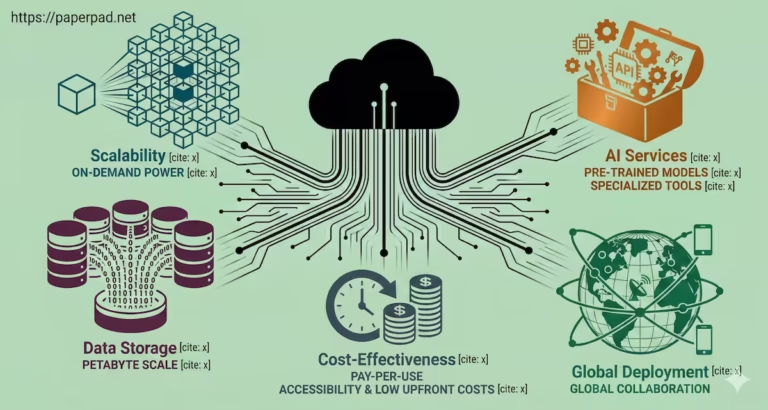
Cloud Computing in AI Cloud AI infographic on a light green background with 5 modules for scalability, services, storage, cost, and deployment.
Cloud Computing provides the massive computational power and flexible infrastructure essential for modern AI. It's crucial for training complex Deep Learning models and managing vast data sets. Key benefits include unmatched scalability, reduced cost, accessibility, and powerful tools. Cloud AI enables rapid experimentation, global deployment, and continuous innovation. Understanding Cloud AI is vital for unlocking AI's full potential and driving its widespread adoption.

What is Edge AI: 5 Powerful Reasons AI Moves to the Source

Infographic of Edge AI benefits: latency, reliability, efficiency, sustainability, and privacy on a sage green background.
Edge AI means running AI processing directly on local devices ("the edge") rather than in a central cloud server. It's crucial for speed, privacy, reliability, and efficiency in many real-world applications. Key benefits include reduced latency, lower cost, enhanced security, and improved autonomy. Edge AI is essential for devices with limited connectivity or strict data handling constraints. Understanding Edge AI is vital for designing intelligent systems that are responsive, secure, and sustainable.

Symbolic AI vs Connectionist AI

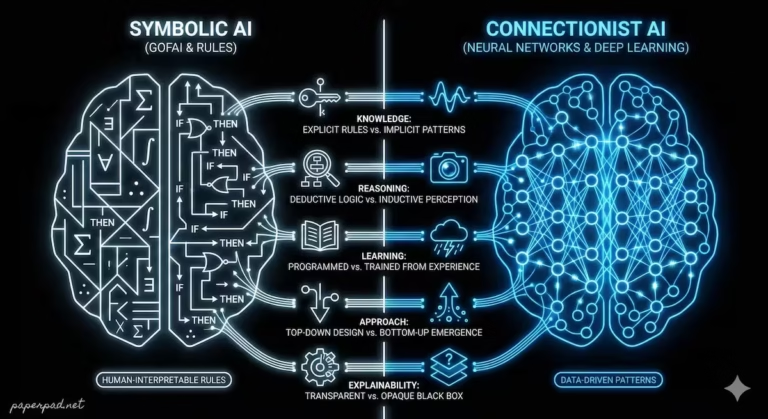
A brain split to compare 'SYMBOLIC AI (GOFAI & RULES)' and 'HUMAN-INTERPRETABLE RULES' (IF-THEN, logic gates) on the left vs. 'CONNECTIONIST AI (NEURAL NETWORKS & DEEP LEARNING)' and 'DATA-DRIVEN PATTERNS' (interconnected neural network) on the right. Five central comparison categories: KNOWLEDGE (Explicit Rules vs Implicit Patterns), REASONING (Deductive Logic vs Inductive Perception), LEARNING (Programmed vs Trained from Experience), APPROACH (Top-Down Design vs Bottom-Up Emergence), and EXPLAINABILITY (Transparent vs Opaque Black Box). 'paperpad.net' is at the bottom left.
Symbolic AI uses explicit rules and symbols to represent knowledge, like a detailed instruction manual. Connectionist AI (like neural networks) learns patterns from data, mimicking brain connections. Early AI focused on symbolic methods; modern AI is dominated by connectionist approaches, especially Deep Learning. Each path has distinct architectures, workflows, and strengths for different types of problems. Understanding these "two paths to machine intelligence" is crucial for appreciating AI's evolution and capabilities.

AI terminology Easy to understand

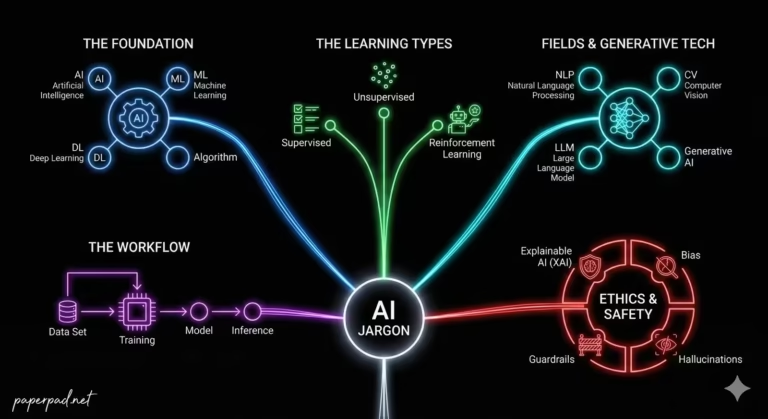
"infographic titled AI terminology: A Visual Map of the Artificial Intelligence Landscape' by paperpad.net. The design features a central 'AI JARGON' node with five branching categories shown in a neon-style aesthetic: The Foundation: Connecting AI, Machine Learning, Deep Learning, and Algorithm. The Learning Types: Featuring Supervised, Unsupervised, and Reinforcement Learning. Fields & Generative Tech: Highlighting NLP, Computer Vision, Large Language Models (LLM), and Generative AI. The Workflow: Illustrating the process flow from Data Set through Training, Model, and Inference. Ethics & Safety: Including Explainable AI (XAI), Bias, Guardrails, and Hallucinations."
AI terminology can be intimidating, but understanding key terms demystifies the field. This glossary provides simple, clear explanations for common AI concepts. From Algorithms to Deep Learning, knowing the language helps you engage with AI meaningfully. Understanding these terms is crucial for informed AI adoption and effective human-AI collaboration. Don't let confusing terms be a constraint to your AI literacy – get AI Jargon Decoded!

Computer Vision: 5 Powerful Ways AI Sees the World

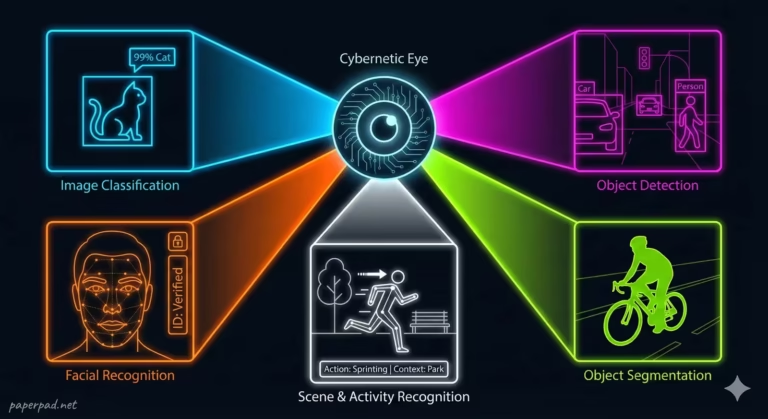
"Infographic titled 'Digital Sight: 5 Ways Computer Vision Interprets Our World' by paperpad.net. The graphic features a central 'Cybernetic Eye' icon radiating five beams, each highlighting a specific computer vision task in a neon aesthetic: Image Classification: A box highlighting a cat with a '99% Cat' label. Object Detection: A street scene identifying a 'Car' and a 'Person' with bounding boxes. Facial Recognition: A digital scan of a face showing an 'ID: Verified' status. Scene & Activity Recognition: A graphic showing a person running in a park with labels 'Action: Sprinting' and 'Context: Park'. Object Segmentation: An outlined silhouette of a person riding a bicycle."
Computer Vision is the field of AI that enables computers to "see," interpret, and understand visual information from images and videos. It translates raw pixels into meaningful data, allowing AI to recognize objects, faces, and scenes. Deep Learning, especially convolutional neural networks, has revolutionized Computer Vision, enabling complex visual tasks. Applications range from self-driving cars to medical diagnosis and quality control in manufacturing. Understanding how Computer Vision works is crucial for developing AI that interacts intelligently with our visual world.
Natural Language Processing (NLP): 5 Best Ways Teaching Computers

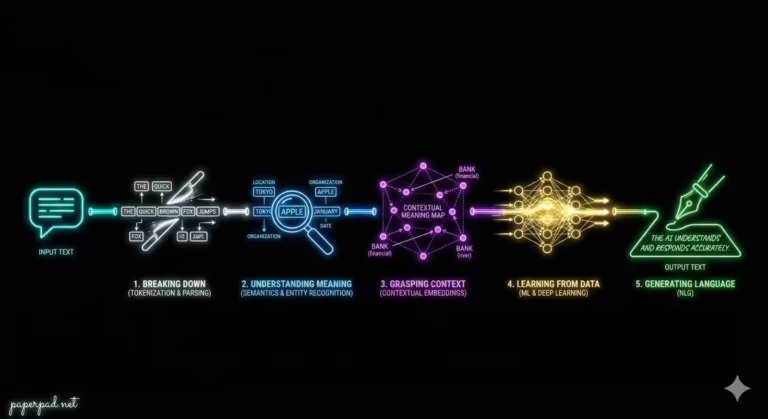
"Infographic titled 'The 5 Stages of Natural Language Processing: Teaching Machines to Speak Human' by paperpad.net. The graphic illustrates a 5-step process in a neon-style flow chart: 1. Breaking Down (Tokenization & Parsing): Represented by text blocks being separated. 2. Understanding Meaning (Semantics & Entity Recognition): Depicted with a magnifying glass focusing on text entities. 3. Grasping Context (Contextual Embeddings): Shown as a network map of interconnected meanings. 4. Learning From Data (ML & Deep Learning): Represented by a glowing neural network structure. 5. Generating Language (NLG): Signified by an icon of a fountain pen writing, representing accurate AI response."
Natural Language Processing (NLP) is the field of AI that enables computers to understand, interpret, and generate human language. It bridges the gap between how humans communicate and how computers process information. NLP uses complex algorithms and Machine Learning to break down language into understandable components. Key applications include chatbots, translation, and sentiment analysis, helping computers grasp context. Understanding NLP is crucial for developing AI that interacts naturally and effectively with people.