
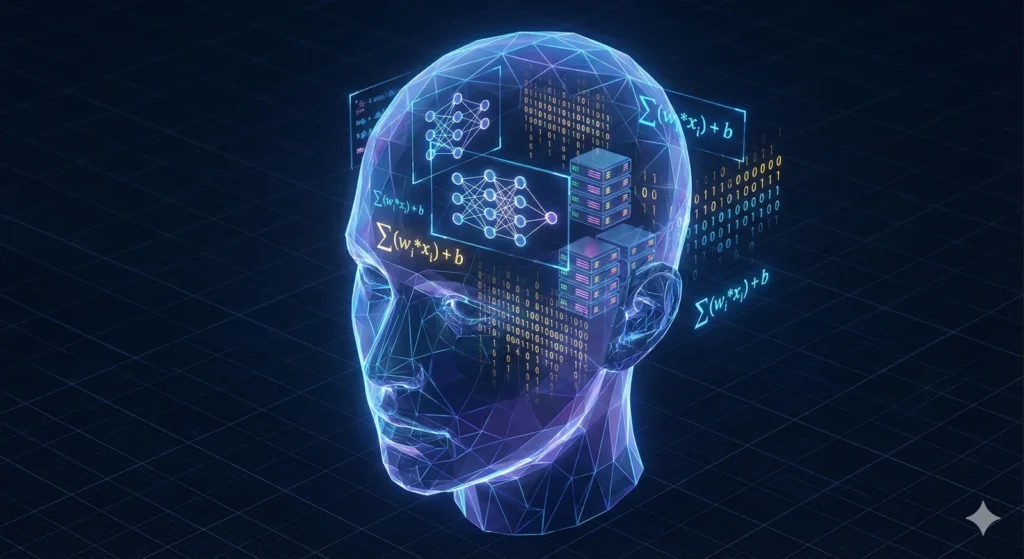
We are all using AI every day, even without realizing it.
Think of your phone suggesting the next word when you type a text message that’s AI. When Netflix recommended a show after you finished one, that was AI. When your email quietly moved a suspicious message to spam before you ever saw it, yes, that’s AI, again.
Let’s find out what artificial intelligence actually means. We hear this word around so much these days that it can start to feel overwhelming. Is it robots? Is it sentient computers? Is it going to take everyone’s jobs?
The honest answer is: it’s none of those things, and all of them a little bit.
By the end of this post, you’ll have a clear understanding of what AI actually means, how it works at a basic level, and the main types you’ll face in your daily life. You don’t need a computer science degree to learn this—just read the post until the end.
Table of Contents
What Does “Artificial Intelligence” Actually Mean?
The term “artificial intelligence” was invented back in 1956 by a computer scientist named John McCarthy. His definition was straightforward: AI is “the science and engineering of making intelligent machines.”
In simple terms, AI is software that can do things we would normally expect to require human thinking.
This includes things like:
- Understanding language: Reading your questions and answering them, like Google’s Gemini AI. You can ask questions in natural language and it answers them. There are even tools available to build your own AI based on your own data. Platforms like CustomGPT can answer all your questions based on the data you feed in. It provides an option to upload your specific data, and you can ask questions related to that data. It is designed for a vast variety of purposes, like making chatbots for your online store or building subject-specific AI agents. (To learn more about CustomGPT, check out “AI in Business“).
- Recognizing images: Identifying a cat in a photo. For example, you can use Google Lens to identify objects in images.
- Creating new images and videos: Generating visuals by just reading a text prompt. AI tools like ImagineArt or Midjourney are designed specifically for this purpose.
- Making decisions: Recommending a product you might like. You can see this in e-commerce apps that recommend products based on your browsing history.
- Learning from experience: Getting better at a task the more it does it.
The word “artificial” just means it’s made by humans, not nature. The word “intelligence” is the tricky part—and honestly, researchers still debate what that word really means when applied to machines.
What’s important to understand right now is this: AI isn’t magic, and it isn’t alive. It’s a very sophisticated set of instructions built on enormous amounts of data, nothing Mysterious.
A Simple Way to Think About How AI Works
Imagine you’re teaching a young child to recognise dogs.
You don’t hand them a rulebook that says “four legs + fur + tail = dog.” Instead, you show them hundreds of dogs. Big ones, small ones, fluffy ones, scruffy ones. Over time, they start to notice patterns. Eventually, they can look at a dog they’ve never seen before and say “dog!”
That’s essentially how modern AI works.
Instead of a child, you have a computer program. Instead of hundreds of dogs, you have millions of labelled examples. The program looks for patterns in those examples, builds a kind of internal model of what a “dog” looks like, and then uses that model to identify new ones.
This process is called machine learning — and it’s the engine behind most of the AI you encounter today. [What Is Machine Learning? A Beginner’s Guide]
The more data you feed the system, and the better that data is, the smarter the AI becomes. That’s why companies like Google and Meta sit on mountains of data — it’s the raw material their AI runs on.
The Main Types of AI
Not all AI is the same. Here are the three most common ways people categorise it:
1. Narrow AI (the kind that exists today)
Narrow AI is built to do one specific thing — and do it very well.
A spam filter is narrow AI. So is the face recognition on your phone, the algorithm that curates your TikTok feed, and the chatbot that answers questions on a retailer’s website. Each one is extremely capable within its lane, but completely useless outside of it. Your spam filter can’t recommend a movie. Your Netflix algorithm can’t write you an email.
Almost every AI product you can buy or use right now is narrow AI.
2. General AI (theoretical — doesn’t exist yet)
General AI would be a machine that can think, learn, and apply knowledge across any area — just like a human can. You could ask it to write a poem, then debug code, then plan a trip, then advise on a medical symptom — and it would handle all of it with genuine understanding.
We don’t have this yet. Despite what some headlines suggest, today’s most advanced AI tools (including ChatGPT) are still narrow AI — just very broad and flexible narrow AI.
3. Superintelligent AI (hypothetical — science fiction territory)
This is the stuff of movies: an AI that surpasses human intelligence in every possible way. It doesn’t exist, and serious researchers debate whether it ever will, or what it would even mean if it did.
For now, you can safely set this one aside.
AI in Everyday Life: Examples You Already Know
AI isn’t coming — it’s already here. You’ve probably used it more today than you think.
On your phone:
- Autocomplete and predictive text
- Voice assistants (Siri, Google Assistant, Alexa)
- Face unlock
When you shop online:
- “Customers who bought this also bought…” recommendations
- Dynamic pricing (prices that change based on demand)
- Fraud detection on your card transactions
When you stream:
- Netflix, Spotify, and YouTube recommendation engines
- Automatic subtitles and language translation
When you search:
- Google’s search results are shaped by AI that tries to understand what you actually mean, not just the words you typed
At work:
- AI writing assistants like Rytr AI (A wonderful writing assistant)
- Customer service chatbots like CustomGPT
The point isn’t to overwhelm you with a list. It’s to show you that AI is already woven into the fabric of everyday life — and most of it makes things quietly easier.
What AI Can’t Do (Yet)
For all its impressiveness, AI has real limitations worth knowing about.
It doesn’t truly understand things. An AI language model doesn’t “know” that Paris is in France the way you do. It has learned that those words appear together very often in its training data. That’s a subtle but important difference.
It can be wrong — confidently. AI systems sometimes produce incorrect information and present it as fact. This is called “hallucination” and it’s a genuine problem, especially with language-based AI tools.
It can reflect human bias. If the data used to train an AI contains biased patterns, the AI will learn and repeat those patterns. This is an active area of research and a serious ethical concern.
It can’t feel, intend, or care. AI doesn’t have motivations. It isn’t plotting anything. It processes inputs and produces outputs. That’s it.
Understanding these limitations makes you a smarter, safer user of AI (Artificial Intelligence) tools.
For a deeper look at how AI actually learns, check out [How Does Machine Learning Actually Work? A Deep Dive].
Is AI Something You Should Be Worried About?
It’s a fair question.
Artificial Intelligence is a powerful tool — and like any powerful tool, it can be used well or badly. There are legitimate concerns worth following: job displacement in some industries, the spread of misinformation through AI-generated content, and questions around privacy and data use.
But fear of AI usually comes from misunderstanding it. The more clearly you understand what it is and how it works, the better placed you are to make good decisions about it — as a worker, a consumer, and a parent.
The goal of this blog is to help you build exactly that kind of clear understanding.
Conclusion
Artificial intelligence, at its core, is software that learns from data to do things we’d normally expect a human to do. It’s already part of your daily life through your phone, your streaming apps, your inbox, and your search engine. The AI that exists today — narrow AI — is impressive but limited. It can’t think, feel, or truly understand. It finds patterns and makes predictions.
The most important takeaway? You don’t need to be a tech expert to understand AI. You just need a clear starting point — and now you have one.
If you found this helpful, take your understanding a step further with [What Is Machine Learning? A Beginner’s Guide].
FAQ’s
What is artificial intelligence in simple terms?
Artificial intelligence is software that can perform tasks that would normally require human thinking — like understanding language, recognising images, or making recommendations. It works by learning from large amounts of data rather than following fixed rules.
What are some examples of AI in everyday life?
You encounter AI daily through voice assistants like Siri and Alexa, Netflix and Spotify recommendations, Google search results, spam filters in your email, and autocomplete on your phone keyboard.
Is AI the same as machine learning?
Not quite. Machine learning is one of the main methods used to build AI — it’s the process where software learns from data. AI is the broader idea of making machines act intelligently. All machine learning is AI, but not all AI uses machine learning.
Is AI dangerous?
AI as it exists today is a tool, not an autonomous agent. It doesn’t have intentions or desires. That said, there are real risks worth taking seriously: AI can reflect biases, spread misinformation, and be misused. Understanding how it works is the best defence against those risks.
What is the difference between narrow AI and general AI?
Narrow AI — which is all that currently exists — does one specific thing very well, like filtering spam or recognising faces. General AI would be a machine that can think and learn across any subject, like a human. General AI remains theoretical.
Can AI think for itself?
No. Current AI systems don’t think — they process. They find patterns in data and generate outputs based on those patterns. There’s no understanding, consciousness, or intention behind it. It’s sophisticated pattern-matching, not independent thought.

One Response
I want create only ai photo
.