Table of Contents
Introduction
AI terminology is often so complex that it acts as a barrier, making it difficult for most people to understand what is actually happening in the field. Terms like “neural networks,” “deep learning,” “algorithms,” and “hallucinations” are thrown around, often without clear explanations. But understanding this language is essential. Just like knowing the ingredients in a recipe helps you understand the dish, knowing these key terms helps you comprehend how AI works, its capabilities, its constraints, and its ethical implications. This glossary aims to demystify some of the most common AI terms, providing simple explanations that empower everyone to engage more confidently with this transformative technology, fostering smarter AI adoption and better human-AI collaboration across all sectors, including emerging markets.
Core Concepts
Think of this as your personal AI terminology handbook. We’ll define terms simply, often with analogies, so you can build your AI literacy.
The Big Picture & Learning
- Artificial Intelligence (AI): The broadest field of computer science dedicated to creating machines that can perform tasks traditionally requiring human intelligence (e.g., reasoning, learning, problem-solving, perception).
- Analogy: The entire “intelligent cooking” project.
- Machine Learning (ML): A subset of AI that enables systems to learn from data, identify patterns, and make decisions with minimal human intervention, without being explicitly programmed for every scenario.
- Analogy: Teaching a computer to cook by giving it many recipes and letting it learn to adapt.
- Deep Learning (DL): A specialized subset of Machine Learning that uses artificial neural networks with many “layers” (hence “deep”) to learn from vast amounts of data, particularly good for complex patterns in images, sound, and text.
- Analogy: Teaching a computer to cook by letting it observe thousands of master chefs and learn nuanced techniques itself.
- Algorithm: A precise, step-by-step set of instructions or rules that a computer follows to solve a problem or complete a task.
- Analogy: A detailed recipe for a computer.
- Neural Network: A computational model inspired by the human brain’s structure, consisting of interconnected “nodes” (neurons) organized in layers, processing information.
- Analogy: A network of tiny “chefs” (nodes) collaborating to prepare a dish.
- Supervised Learning: An ML method where the AI learns from labeled data (input-output pairs), like a student with an answer key.
- Unsupervised Learning: An ML method where the AI finds hidden patterns or structures in unlabeled data, like a student sorting toys without instructions.
- Reinforcement Learning: An ML method where an AI agent learns to make decisions by interacting with an environment, receiving rewards for good actions and penalties for bad ones (trial and error).
How AI Works & Interacts
- Data Set: A collection of data (e.g., images, text, numbers) used to train, test, and evaluate an AI model. The quality and representativeness of the dataset are crucial.
- Model: The output of a Machine Learning algorithm after training on a dataset. It’s the “learned” representation that can make predictions or decisions on new data.
- Training: The process of feeding data to an ML algorithm to allow it to learn patterns and adjust its internal parameters (weights) to perform a specific task.
- Inference: The process of using a trained AI model to make predictions or decisions on new, unseen data.
- Natural Language Processing (NLP): A branch of AI that enables computers to understand, interpret, and generate human language.
- Computer Vision (CV): A branch of AI that enables computers to “see,” interpret, and understand visual information from images and videos.
Advanced Concepts & Responsible AI
- Large Language Model (LLM): A type of Deep Learning model, trained on massive amounts of text data, capable of understanding, generating, and even translating human-like text. (e.g., ChatGPT, Bard).
- Generative AI: AI that can create new content (text, images, audio, video) that is original and realistic, rather than just analyzing existing data.
- Explainable AI (XAI): Methods and techniques that help humans understand why an AI system made a particular decision, rather than just knowing what it decided. Addresses the “black box” problem.
- Bias (in AI): Systematic and repeatable errors in an AI system’s output that lead to unfair or discriminatory treatment of individuals or groups, often stemming from biased training data.
- Hallucinations (in AI): When an AI (especially an LLM) generates plausible-sounding but factually incorrect or nonsensical information, essentially “making things up.”
- Guardrails: Predefined rules, constraints, or mechanisms put in place to ensure an AI system operates safely, ethically, and within desired parameters, preventing unintended or harmful behavior.
How It Works
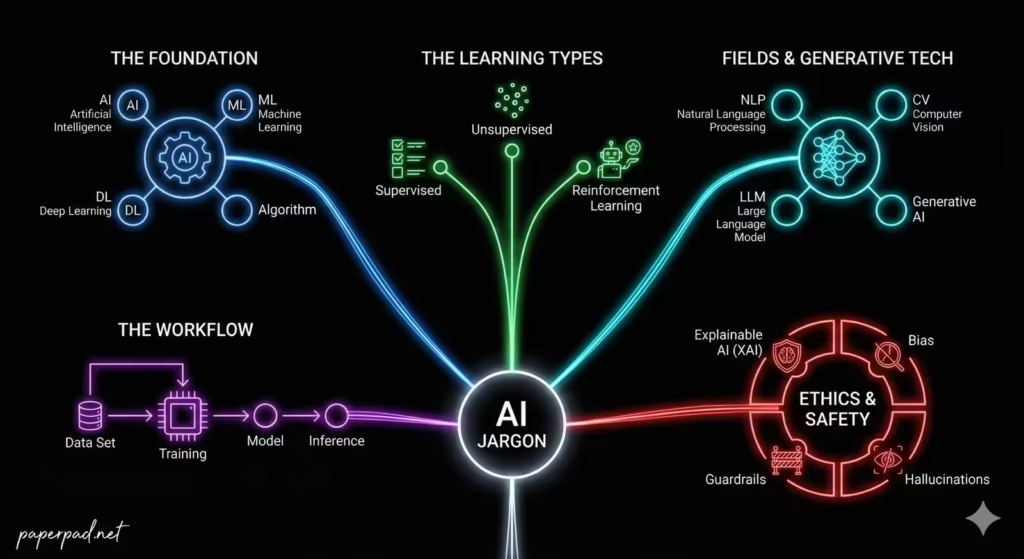
Understanding these terms helps you trace the workflow of an AI system. For example, a Data Set is collected and used for Training a Machine Learning Model (often a Deep Learning-based Neural Network) via Supervised Learning. Once trained, this Model can then perform Inference on new data. If it deals with text, it uses NLP; if it deals with images, it uses Computer Vision. Throughout this, Explainable AI (XAI) helps us understand its decisions, while Guardrails are essential to prevent Bias and Hallucinations, ensuring the AI’s objective is met responsibly.
Real-World Examples
Let’s see how these terms come alive in everyday scenarios:
- Your Smartphone’s Face Unlock: This relies on Computer Vision to detect your face and uses Deep Learning Algorithms trained on a Data Set of faces to perform Inference (recognize you) and unlock your phone.
- Chatbots: When you interact with a customer service chatbot, it uses Natural Language Processing (NLP) to understand your questions and generate responses. The underlying Large Language Model (LLM) was developed using Generative AI techniques. If it gives you a strange answer, it might be “hallucinating.”
- Spam Filter: An email spam filter is a classic example of Supervised Learning. It was trained on a Data Set of emails labeled as “spam” or “not spam.” The Algorithm learned patterns to classify new emails.
- Product Recommendations: When an online store suggests items you might like, it’s often using Unsupervised Learning Algorithms to find patterns in customer behavior within its vast Data Set of purchases and browsing history.
- Self-Driving Cars: These complex AI agents integrate Computer Vision (to “see” the road), Reinforcement Learning (to learn optimal driving strategies), and numerous other algorithms to navigate autonomously. Strict guardrails are in place for safety.
Benefits, Trade-offs, and Risks
Benefits of Understanding AI AI terminology
- Empowerment: Demystifies AI, allowing you to participate in discussions and decisions about its role.
- Informed Decisions: Helps you evaluate AI products and services more critically, understanding their capabilities and constraints.
- Better Collaboration: Facilitates more effective communication between technical and non-technical teams, fostering human-AI collaboration.
- Ethical Awareness: Enables you to identify potential bias, privacy concerns, and ethical dilemmas associated with AI.
Trade-offs/Limitations
- Evolving Terminology: The field of AI is dynamic, and new AI terminology emerges constantly, requiring continuous learning.
- Nuance: Simple definitions can sometimes oversimplify complex concepts, but they serve as a starting point.
Risks & Guardrails
- Misinformation: Lack of understanding makes individuals susceptible to hype or fear-mongering about AI.
- Poor Adoption: Without clear communication, businesses might fail to see the true ROI of AI or adopt inappropriate solutions.
- Ethical Blind Spots: Unawareness of terms like “bias” or “explainability” can lead to overlooking critical ethical considerations in AI development and deployment.
- Guardrail: Use reliable sources (like this blog!) to learn new terms, and always ask for clarification when you encounter AI terminology you don’t understand.
What to Do Next / Practical Guidance
Building your AI vocabulary is a continuous journey.
- Now (Start Simple):
- Review This Glossary: Re-read these terms and try to connect them to AI examples you encounter daily.
- Listen Actively: When you hear an AI term, try to recall its definition. If you don’t know it, look it up!
- Don’t Be Afraid to Ask: In discussions, politely ask for clarification if a term is unclear.
- Metrics to Watch: How many AI terms can you now confidently define?
- Next (Deepen Your Understanding):
- Read More: Explore introductory articles and blogs on specific AI topics (like those planned in our series!).
- Watch Explainer Videos: Visual explanations can be very helpful for complex concepts.
- Connect Concepts: Start seeing how these terms fit together in the larger AI workflow and architecture.
- Metrics to Watch: Can you explain how two or three terms relate to each other (e.g., how Deep Learning is part of Machine Learning)?
- Later (Become an AI Advocate):
- Explain to Others: The best way to solidify your understanding is to explain AI concepts to someone else.
- Participate in Discussions: Engage in conversations about AI’s impact, bringing your informed perspective.
- Advocate for Clarity: Encourage others to use clear language and define terms when discussing AI.
- Metrics to Watch: Your ability to critically assess AI news, identify potential bias, and contribute to ethical governance.
Common Misconceptions
- “AI terminology is just for experts”: While some terms are technical, many are becoming part of general literacy due to AI’s widespread impact.
- “Learning terminology means I’m an AI expert”: Understanding terms is the first step; true expertise comes from applying and building AI.
- “All AI terms are interchangeable”: AI, ML, and DL are related but distinct concepts. Using them precisely improves communication.
- “AI terminology is designed to confuse”: Often AI terminology arises from the need for precise, specialized language within a field, though it can inadvertently create barriers.
- “There’s too much to learn”: Start with the core concepts, and build your knowledge incrementally, focusing on what’s relevant to your interests.
Conclusion
Understanding AI terminology is a crucial step towards fostering a more informed and engaged society in the age of Artificial Intelligence. By understanding these 15+ Terms Decoded for All, you gain the ability to comprehend how AI systems operate, what their capabilities and constraints are, and how they impact our world. This glossary serves as a foundational tool for navigating the complex landscape of AI, enabling more effective human-AI collaboration, promoting responsible AI adoption, and ensuring that the future of intelligent technology is shaped by understanding, not by confusion.