

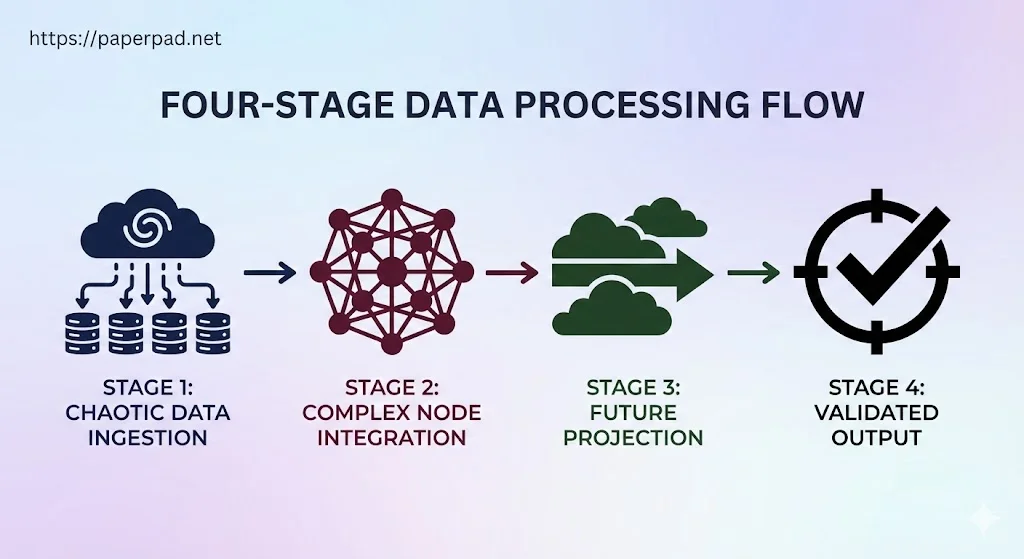
- Algorithm is a precise, step-by-step instructions that tell a computer how to solve a problem or complete a task.
- Think of them as recipes for computers, ensuring consistent and predictable outcomes.
- In AI, algorithms are the “brains” that process data, learn patterns, and make decisions.
- They are fundamental to Machine Learning, enabling AI to discover insights and predict outcomes.
- Understanding algorithms is key to comprehending how AI works, its constraints, and its potential impact.
Table of Contents
Introduction
When discussing Artificial Intelligence (AI), we hear the word “Algorithm” many times. From social media feeds to search engine results, algorithms are constantly at work behind the scenes. Let’s understand what exactly are they? Simply put, Algorithm means understanding the precise, step-by-step instructions that tell a computer how to perform a task or solve a problem. Think of them as the meticulously crafted “recipes” that power every decision an AI makes. Without algorithms, AI wouldn’t be able to learn, recognize patterns, or generate responses. They are the fundamental building blocks of AI’s intelligence, defining its workflow, its architecture, and ultimately, its effectiveness in real-world applications, from optimizing logistics in bustling cities to assisting farmers in remote villages.
Core Concepts
Let’s break down what an algorithm truly is, beyond the buzzword:
- What is an Algorithm?
- Definition: An algorithm is a finite sequence of well-defined, unambiguous instructions, typically used to solve a class of problems or to perform a computation. It’s a precise procedure that, when followed, will reliably produce a result.
- Analogy: Imagine a baking recipe. It has a clear list of ingredients (inputs), a set of ordered steps (the algorithm itself: “mix flour and sugar,” “add eggs,” “bake at 350°F for 30 minutes”), and a desired outcome (the cake). If you follow the recipe correctly, you’ll get a cake every time. If the recipe is flawed, or if you skip a step, the outcome won’t be right.
- In Computing: For computers, these instructions are translated into code. The computer executes these instructions mechanically, without needing to “understand” the goal, only to follow the steps.
- Now let’s learn what is an AI Algorithm?
- In AI, algorithms are central to how machines “learn” and make “intelligent” decisions. They are the mathematical and logical procedures that enable AI systems to:
- Process Data: Sift through vast amounts of information.
- Identify Patterns: Find relationships and trends that humans might miss.
- Make Predictions: Forecast future events or classify new inputs.
- Optimize Solutions: Find the best possible answer to a problem given certain constraints.
- They are the “brains” of the AI agent, providing the internal logic for its autonomy and decision-making.
- In AI, algorithms are central to how machines “learn” and make “intelligent” decisions. They are the mathematical and logical procedures that enable AI systems to:
- Types of AI Algorithm:
- While there are countless specific algorithms, they generally fall under categories like:
- Supervised Learning AI Algorithm: (e.g., Linear Regression, Decision Trees, Support Vector Machines) — learn from labeled data.
- Unsupervised Learning AI Algorithm: (e.g., K-Means Clustering, Principal Component Analysis) — find patterns in unlabeled data.
- Reinforcement Learning AI Algorithm: (e.g., Q-learning, Policy Gradients) — learn through trial and error with rewards.
- Neural Network AI Algorithms: (e.g., Backpropagation) — used to train deep learning models.
- While there are countless specific algorithms, they generally fall under categories like:
How It Works
An algorithm’s workflow is typically a clear, logical sequence. Let’s take a simple example of a common algorithm used in AI: a Decision Tree.
- Objective: Classify an email as “Spam” or “Not Spam.”
- Input: An email with various characteristics (e.g., sender, subject line keywords, presence of attachments).
- Algorithm (Decision Tree Recipe):
- Step 1 (First Question): Does the email contain the word “free” in the subject line?
- If YES, go to Step 2.
- If NO, go to Step 3.
- Step 2 (Second Question – if “free” was present): Is the sender’s address from a known spam domain?
- If YES, classify as SPAM.
- If NO, go to Step 4.
- Step 3 (Second Question – if “free” was NOT present): Does the email have an attachment?
- If YES, go to Step 4.
- If NO, classify as NOT SPAM.
- Step 4 (Final Question): Is the email addressed to multiple unknown recipients?
- If YES, classify as SPAM.
- If NO, classify as NOT SPAM.
- Step 1 (First Question): Does the email contain the word “free” in the subject line?
- Output: A classification: “Spam” or “Not Spam.”
This step-by-step process, often part of a larger pipeline, dictates the AI’s decision. The complexity comes from how these “questions” or “rules” are learned from data (Machine Learning) and how many layers of decisions are involved (Deep Learning). Guardrails are built around these algorithms to ensure they operate within acceptable parameters and to prevent unintended consequences.
Real-World Examples
Algorithms are the invisible engines powering countless AI applications.
- Personalized Content Recommendations (Entertainment/E-commerce):
- Scenario: Netflix suggesting your next binge-watch or Amazon recommending products.
- How it works: Algorithms analyze your past viewing/purchase history, ratings, browsing behavior, and what similar users like. They then use this data to predict what you might enjoy next. Collaborative filtering algorithms, for instance, identify patterns in user preferences and make recommendations. This is a continuous feedback loop where your choices help refine the algorithm’s predictions.
- Emerging Market Context: In regions with diverse languages and cultural content, recommendation algorithms help local creators reach audiences and users discover locally relevant content, driving adoption of digital platforms despite varied internet speeds.
- Credit Scoring and Loan Approval (Finance):
- Scenario: A bank deciding your eligibility for a loan.
- How it works: Financial institutions use algorithms to assess credit risk. These algorithms process vast amounts of data—your financial history, income, debt, and payment behavior—to calculate a credit score or predict your likelihood of repayment. This decision-making workflow is designed to minimize risk while maximizing ROI for the lender, all while adhering to strict compliance regulations.
- Emerging Market Context: Where traditional credit data is scarce, algorithms are being adapted to analyze alternative data sources like mobile phone usage, utility payments, or even social network data (with strict privacy guardrails) to provide micro-loans or financial services to previously unbanked populations.
- Route Optimization (Logistics & Delivery):
- Scenario: Your food delivery app finding the fastest way to get your meal to you.
- How it works: Graph algorithms (like Dijkstra’s or A* search) are used to find the shortest or fastest path between multiple points, considering real-time traffic, road closures, and delivery priorities. These algorithms are the core tools used by AI agents managing fleets of vehicles, constantly recalculating routes to meet their objective of efficient delivery, reducing latency and cost.
- Emerging Market Context: In cities with complex or informal addressing systems, or unreliable infrastructure, algorithms can integrate GPS data, local knowledge, and real-time conditions to optimize delivery routes, making logistics more efficient and reliable, which is crucial for e-commerce growth.
Benefits, Trade-offs, and Risks
Benefits
- Efficiency: Automate complex tasks, performing them faster and more consistently than humans.
- Scalability: Can handle enormous volumes of data and operations, far beyond human capacity.
- Objectivity (Potential): When well-designed, algorithms can apply rules consistently, reducing human bias in decision-making (though they can also perpetuate it if not carefully built).
- Discovery: Can uncover hidden patterns and insights in data that would be impossible for humans to find.
Trade-offs/Limitations
- Bias Amplification: If the data fed into an algorithm is biased, the algorithm will learn and amplify that bias, leading to unfair or discriminatory outcomes.
- Lack of Common Sense/Context: Algorithms operate purely on defined instructions and data; they lack human intuition, common sense, or understanding of nuanced real-world context.
- “Garbage In, Garbage Out”: An algorithm’s output is only as good as its input data. Flawed data leads to flawed decisions.
- Complexity: Some advanced algorithms, especially in Deep Learning, can be incredibly complex, making it hard to understand why they make certain decisions (explainability).
Risks & Guardrails
- Ethical Concerns: Algorithms making decisions about people’s lives (e.g., credit, hiring, justice) raise significant ethical questions about fairness, accountability, and transparency.
- Security Vulnerabilities: Algorithms can be exploited by malicious actors, leading to data breaches or manipulation of outcomes. Robust security measures are critical.
- Privacy Invasion: Many algorithms rely on vast amounts of personal data, necessitating strict privacy regulations and careful governance.
- Unintended Consequences: A poorly designed or deployed algorithm can lead to unforeseen negative outcomes. Strong guardrails, rigorous evaluation, and human-in-the-loop oversight are essential.
- Lack of Transparency: The “black box” nature of some algorithms can hinder public trust and make auditing difficult, impacting compliance.
What to Do Next / Practical Guidance
Understanding algorithms is key to engaging with AI responsibly.
- Now (Learn the Basics):
- Demystify: Don’t be intimidated by the term. Think of algorithms as logical problem-solving steps.
- Question: When you interact with an AI system, ask yourself, “What instructions is this system likely following?”
- Focus on Inputs/Outputs: Recognize that an algorithm takes inputs and produces outputs based on its internal logic.
- Metrics to Watch: Understand that algorithms are judged by their “accuracy” (how often they are right) and “efficiency” (how fast they run).
- Next (Explore Applications & Impact):
- Identify Everyday Algorithms: Notice where algorithms influence your life (recommendations you see on marketplace apps, search results when we start typing on google search, traffic apps etc.).
- Consider Ethical Implications: Think about the potential for bias or unintended consequences in algorithmic decision-making.
- Understand Data’s Role: Recognize that the data used to “train” or feed an algorithm is just as important as the algorithm itself.
- Metrics to Watch: Start considering “fairness metrics” (is the algorithm equally accurate across different groups?) and “explainability” (can we understand its decisions?).
- Later (Engage & Govern):
- Advocate for Transparency: Support initiatives for clearer understanding of how algorithms work, especially in critical applications.
- Demand Guardrails: Insist on robust guardrails, auditing, and human-in-the-loop processes for AI systems.
- Develop Algorithmic Literacy: For professionals, understanding the types of algorithms and their appropriate uses is becoming a vital skill for maximizing ROI and ensuring compliance.
- Metrics to Watch: Focus on broader societal impacts, governance effectiveness, and the long-term ROI of ethical AI deployment.
Common Misconceptions
- “Algorithms are inherently biased”: Algorithms are not biased on their own; they reflect and amplify the biases present in the data they are trained on, or the humans who design them.
- “Algorithms are always fair”: Fairness is a complex concept. An algorithm can be statistically fair in one way but unfair in another. It requires careful definition and guardrails.
- “Algorithms are purely mathematical”: While mathematical, their design involves human choices, ethical considerations, and real-world context.
- “Algorithms are static”: Many AI algorithms, especially in Machine Learning, continuously learn and adapt based on new data and feedback loops.
- “Only coders need to understand algorithms”: As algorithms increasingly shape our world, a basic understanding is becoming essential for everyone to navigate the digital landscape critically.
Conclusion
Algorithms are the foundational “recipes” that empower AI systems to process information, learn from data, and make decisions. From simple sorting tasks to complex predictive analytics, they define the workflow and architecture of artificial intelligence. While incredibly powerful and efficient, algorithms are not without their constraints and risks, particularly concerning bias and transparency. By understanding these decision-making recipes, how they are built, and the guardrails needed for their responsible use, we can better harness AI’s potential to solve problems, drive innovation, and shape a more intelligent future.
Going further we will discuss AI Ethics, a way forward to building a responsible AI future.