PaperPad

Tap your Interest

Transformer Architecture, How it Works: Simply Explained

A glowing, multi-layered digital illustration of an AI model stack (Transformer Architecture) against a dark background. At the bottom, text tokens like "data", "input", and "phrase" transform into numerical data grids. Above this are four transparent, illuminated layers connected by amber and blue light pathways. The central layers have a strong orange/yellow glow. At the very top, above a final bright layer, the word "SYNTHESIS" is displayed in large, glowing white capital letters. The overall style is modern, dynamic, and technical.
Learn how the transformer architecture works — the engine behind every major AI today. Explained simply, step by step, with an interactive diagram.

How Large Language Models (LLMs) Actually Work

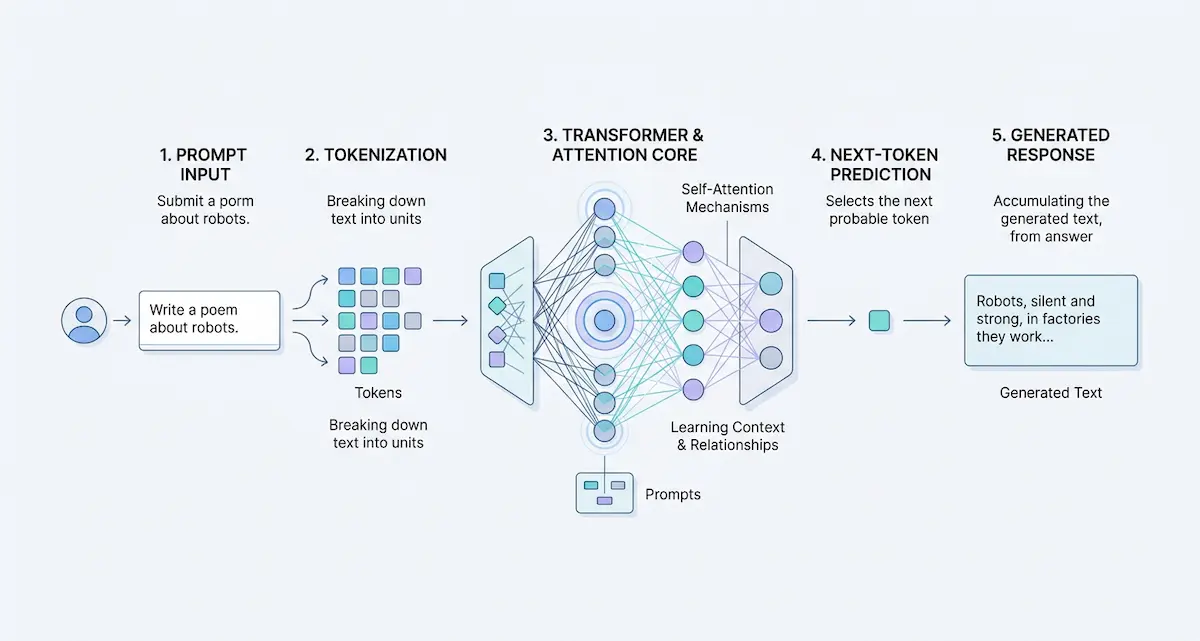
Illustration of how large language models work, showing text input breaking into tokens, passing through transformer attention layers, and generating an output response.
How ChatGPT and other AI tools actually generate text? This guide explains how large language models work — in plain English, no PhD required.

How to write AI Prompts: 7 Powerful Tips to Master Prompt Engineering

ai prompts: 3D isometric illustration of a person at a desk with a holographic screen showing a prompt box and emerging 3D elements: a dog, chart, and storybook.
Master the art of Prompt Engineering with these 7 essential strategies. Learn how to provide context, define structure, and iterate your way to perfect AI-generated content. Stop guessing and start directing.

Generative AI: 5 Top Ways AI Creates New Content

Generative AI infographic: LLMs, GANs, Diffusion, and Multimodal models on light gradient background with paperpad.net watermark.
Generative AI Explained: Explore 5 powerful ways AI creates new content, from LLMs to GANs and Diffusion Models. Understand how machines generate text, images, and more.

Quantum Computing & AI: 5 Powerful Reasons for a Future Partnership

Quantum computing AI infographic: Central processor node connecting to ML, data, security, and optimization modules on a light gradient.
Quantum Computing & AI: Explore 5 powerful reasons why this future partnership could revolutionize AI. Understand how quantum computing can accelerate Machine Learning, data processing, and model optimization.

AI Hardware : 5 Powerful Chips Driving the AI

AI Hardware The FPGA's Role in Adaptability and Rapid Prototyping
The AI Revolution is fueled by specialized hardware, moving beyond traditional CPUs. GPUs (Graphics Processing Units) are key, excelling at parallel processing for Deep Learning. TPUs (Tensor Processing Units) are custom-built by Google specifically for AI workloads. These chips provide the immense computational power needed for training complex AI models. Understanding these "powerful chips" is crucial for appreciating AI's capabilities and scalability.