
Table of Contents
The Question Every Parent Is Really Asking
Situation: It’s 6:30 PM and dinner is half-cooked. Your youngest is crying, and your oldest has been on the iPad for two hours. To buy five minutes of peace, you hand over your phone, but right away, you feel guilty.
Sound familiar?
You’re not failing as a parent. You’re living in a world where screens are woven into absolutely everything — school, work, play, and connection. The question isn’t whether your child will have screen time. They will. The real question is: how much is too much, and what does the research actually say?
That’s exactly what this post is here to answer. You’ll find the latest guidelines from pediatricians and child development experts, what the science shows about how screens affect growing brains and bodies, and clear signs to watch for at home. No guilt trips. Just useful, honest information you can actually use.
What the Research Actually Says About Screen Time
Here’s something worth knowing right away: the research on screen time is more nuanced than the headlines usually suggest.
Scientists don’t say all screen time is harmful. What they consistently find is that excessive and passive screen use — especially in very young children — is linked to a range of developmental concerns. The broader evidence across studies of children aged 0 to 18 years points to a connection between higher levels of screen use and outcomes such as reduced physical activity, poorer sleep, attention difficulties, and challenges in emotional and social functioning.
But the picture isn’t entirely bleak, and the headlines that make screen time sound like pure poison don’t tell the whole story.
A large study of nearly 12,000 children aged nine to ten in the United States found that more screen time was mildly linked to worse mental health, more behaviour problems, lower academic performance, and poorer sleep — but also to slightly better peer relationships. The word “mildly” matters here. Screens are not the single catastrophic force that some parenting content would have you believe. PubMed Central
What the research is very clear about, however, is that younger children are more vulnerable — and the earlier the exposure, the more it matters.
A 2026 study published in Cureus followed young children with an average age of just under 28 months. It found that children exposed to more than two hours of screen time per day were twice as likely to show developmental delays, with the strongest associations found in the social development domain. nih
The first five years of life are when the brain does its most intense building work — language, attention, social understanding, emotional regulation. During that window, what a child does instead of watching a screen matters enormously.
“Screens are not the enemy. But they can crowd out the things that matter most for a young child’s development: movement, conversation, play, and sleep.”
The AAP Screen Time Guidelines — And What They Really Mean
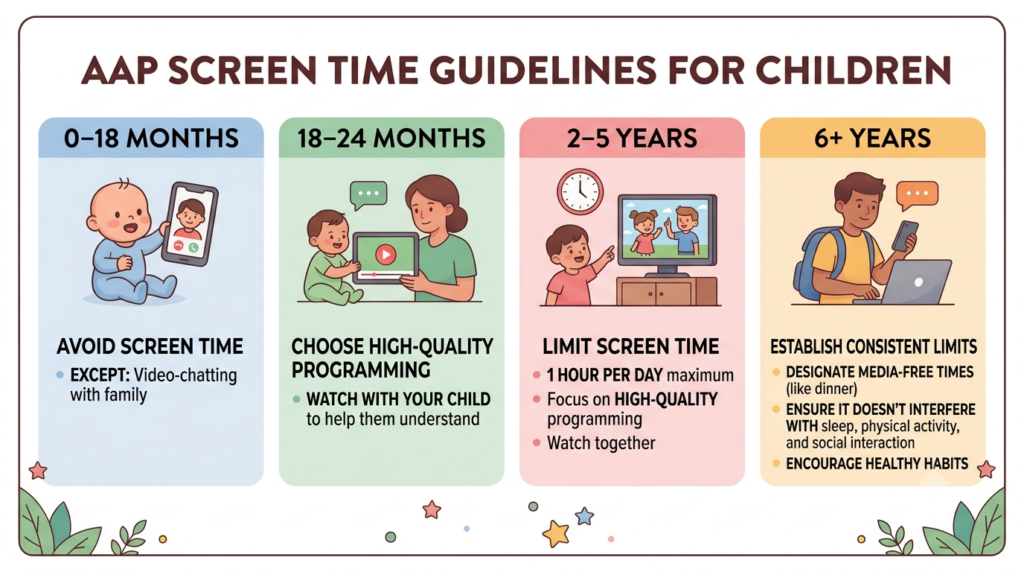
The American Academy of Pediatrics (AAP) — the largest organization of pediatricians in the United States — sets the most widely followed screen time guidelines for children. Their current approach has shifted in a meaningful direction. Rather than focusing purely on clock-watching, the AAP now prioritizes quality, context and conversation over strict time limits. CHOC
That said, they still provide clear age-based guidance. Here’s what it says.
Under 18 Months: Avoid Screens (Except Video Calls)
For children under 18 months, the consensus across pediatric experts is clear: avoid all passive screen time. This strict guideline exists because early learning in this stage relies almost entirely on real-world, interactive engagement. Blueberry Pediatrics
The one exception is video chatting with grandparents, relatives, or close friends. This is considered interactive and social — a fundamentally different experience from passively watching content.
Something many parents don’t know: background TV counts. Studies show that having the television or other devices on in the background is discouraged because background media distracts babies and may negatively affect their language development. The noise and movement of a TV in the room — even when no one is watching it intentionally — pulls a baby’s attention away from the face-to-face interaction they need to learn language. Blueberry Pediatrics
Ages 18–24 Months: High-Quality Content Only, With You Present
At this stage, some educational screen time can be introduced — but only with parental involvement. Parents should select high-quality programs and watch them with their children to help aid comprehension. Commonwealthpeds
The key phrase: watch with them. A toddler watching a screen alone is not the same experience as a parent pointing to the screen, naming characters, and talking about what’s happening. The conversation around the content is where most of the learning actually happens.
Ages 2–5 Years: Up to One Hour Per Day of High-Quality Content
Both the AAP and the World Health Organization (WHO) align on this age group: the daily limit for structured, high-quality passive screen time is one hour per day. Blueberry Pediatrics
One hour. And “high-quality” matters. PBS Kids, educational apps designed with child development principles, and parent-recommended programmes look very different from YouTube autoplay or a fast-paced cartoon that holds attention through sensory chaos rather than learning.
Children aged 3 and 4 need at least 180 minutes — three hours — of physical activity every day. Screen time and movement aren’t separate issues; they compete for the same hours in the day. Blueberry Pediatrics
Ages 6 and Older: Consistent Limits, Not a Number
Here’s where many parents are surprised. The AAP does not give a specific daily hour limit for children six and above. Instead, they recommend placing consistent limits on screen time to ensure it doesn’t interfere with sleep, physical activity, and other healthy behaviors. Commonwealthpeds
The guiding question isn’t “how many hours?” It’s: Is screen use getting in the way of the things that matter?
Sleep. Homework. Family meals. Physical activity. Real friendships. Time outdoors.
If screens are crowding those out, that’s the problem — regardless of the number on the timer.
Getting this right takes more than one article.
Subscribe to PaperPad for practical, research-backed guidance on raising kids in the digital age — delivered simply, without the overwhelm. Join Us for Free.
The Type of Screen Time Matters More Than You Think
Here’s the nuance that the “two hours maximum!” headlines always skip over.
Not all screen time is the same. There’s a world of difference between:
- A 4-year-old Facetiming with their grandparents across the country
- A 7-year-old building a story using an educational coding app
- A 3-year-old watching autoplay YouTube videos for 90 minutes alone
- A teenager doom-scrolling social media before bed
The AAP explicitly acknowledges this. The organisation frames screen use through three lenses: quality, context, and conversation. All three matter. CHOC
Quality means: Is this content educational? Age-appropriate? Does it slow down enough for a child to follow and learn? Fast-paced content designed to hold attention through rapid cuts and sensory stimulation is the most concerning — and it’s also the most common on platforms children naturally gravitate toward.
Context means: Is the child alone, or is a parent nearby? Is it a wind-down before bed (where all experts agree screens are problematic), or a short period after school? Is the device replacing family interaction, or complementing it?
Conversation means: Are you talking about what they watched? Asking questions? Connecting the content to real life? This is how educational media actually produces learning — through the discussion, not the viewing itself.
Research shows that co-viewing and topic-appropriate content are key in determining how language development is affected by screen media. Excessive screen use has also been shown to reduce the amount and quality of interaction between children and their caregivers, which itself can influence language development. PubMed Central
So if your child has watched an hour of quality programming and you’ve spent ten minutes chatting about it afterward, that is fundamentally different from two hours of solo streaming — even at the same total time.
Warning Signs That Screen Time Has Become Too Much
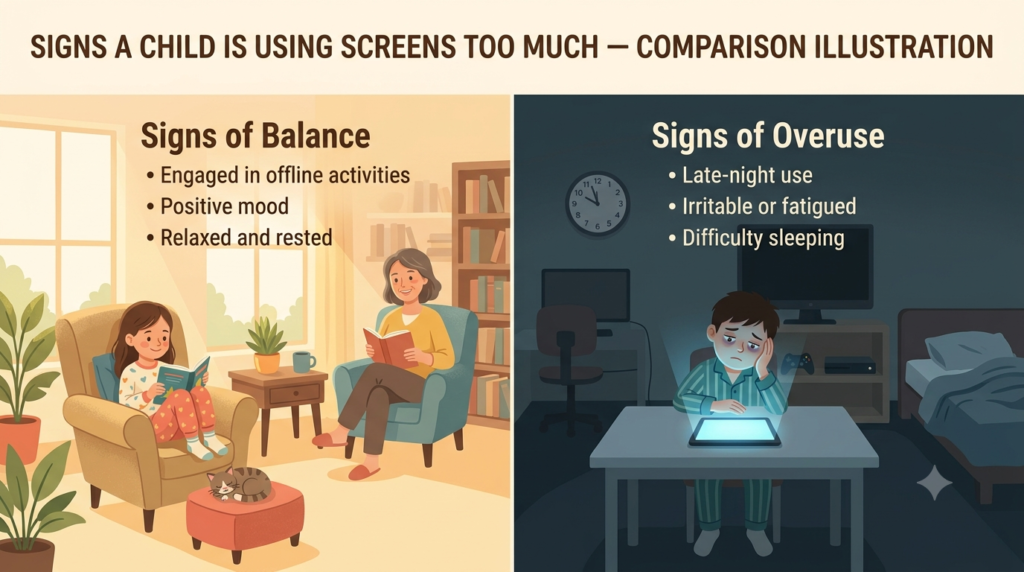
Rules are useful, but your observations as a parent are more valuable than any timer. Here are the signs researchers and pediatricians point to as indicators that screens have crossed from entertainment into a problem:
Behavioural signs:
- Angry, tearful, or aggressive reactions when screens are switched off
- Increasing difficulty engaging in non-screen activities (play, reading, outdoor time)
- Rapidly escalating demands for more screen time
- Mood changes that seem tied to whether devices are accessible
Sleep signs:
- Difficulty falling asleep, especially when devices are used within an hour of bedtime
- Sleeping significantly fewer hours than recommended for their age
- Waking tired despite adequate time in bed
Social and developmental signs:
- Less interest in interacting with family members
- Decreased attention span in non-screen contexts
- Delayed speech or language development (particularly in under-5s)
- Avoiding eye contact or face-to-face conversation
Physical signs:
- Complaints of headaches or eye strain
- Sedentary behaviour for long stretches — no outdoor play, no physical activity
Research across large populations of children has linked excessive screen time to a range of developmental and behavioral issues, including speech disorders, attention difficulties, and sleep disturbances — with stronger associations in preschoolers. Extensionjournal
One or two of these signs on one bad day doesn’t mean there’s a crisis. But if several of these are showing up regularly, it’s worth taking an honest look at how screens are being used in your home.
What “Too Much” Looks Like in Real Life
Research shows the average child in the 8–18 age range is on a device for around 6 hours a day, with more than one in ten spending over 8 hours on devices daily. Newcanaanpediatrics
Six hours. Let that settle for a moment.
That figure includes school use, yes — but also recreational scrolling, gaming, and streaming. For children in this age group, that’s often more time staring at screens than sleeping.
For younger children, the numbers are similarly striking. A study of over 100,000 children aged 0 to 17 found that 70 per cent of preschoolers and 80 per cent of older children and adolescents were already exceeding recommended screen time limits. Extensionjournal
The majority of children are over the guidelines. Which means if your child is, too, you are dealing with a very normal situation — not a parenting failure. The goal isn’t to make you feel bad. It’s to give you a realistic picture of where the average currently sits, so you can make informed decisions about what you’d like to change.
“Too much” isn’t a precise hour count for every family. It’s when screens are consistently getting in the way of:
- Enough sleep for their age
- Daily physical movement
- Real conversations with you
- Play that doesn’t involve a screen
- Attention and engagement in school
If those boxes are ticked, your family is probably in a healthy place — whatever the clock says.
[AI Basics — Is AI Safe for Kids? What Every Parent Needs to Know]
AI tools are now part of many children’s daily digital lives. If you’re wondering what parents need to know about AI and kids, this post is the place to start.
Practical Ways to Reset Screen Time in Your Home
If you’ve read this far and feel like some things need to shift, here are the practical steps that child development experts recommend most consistently.
1. Set clear, consistent screen-free zones
Bedrooms and dinner tables are the two most impactful places to remove screens. Screens in bedrooms are associated with poorer sleep and higher total screen consumption. Phones at the dinner table reduce conversation quality for both children and adults.
2. Turn off autoplay and remove content queues
Autoplay is engineered to override the natural stopping point. Many platforms are specifically designed to keep children engaged as long as possible, using features like autoplay and endless scrolling that can crowd out sleep, physical activity, and family time. Switching off autoplay is a simple settings change that makes a real difference. CHOC
3. Watch together when you can
It doesn’t have to be every time. But sitting with your child for part of their screen time — asking questions, making observations, connecting it to real life — transforms passive viewing into something more valuable.
4. Create a family media plan
The AAP has a free Family Media Plan tool on their website that helps families set their own age-appropriate rules together. Involving children in setting the rules dramatically increases the likelihood they’ll follow them.
5. Offer appealing alternatives
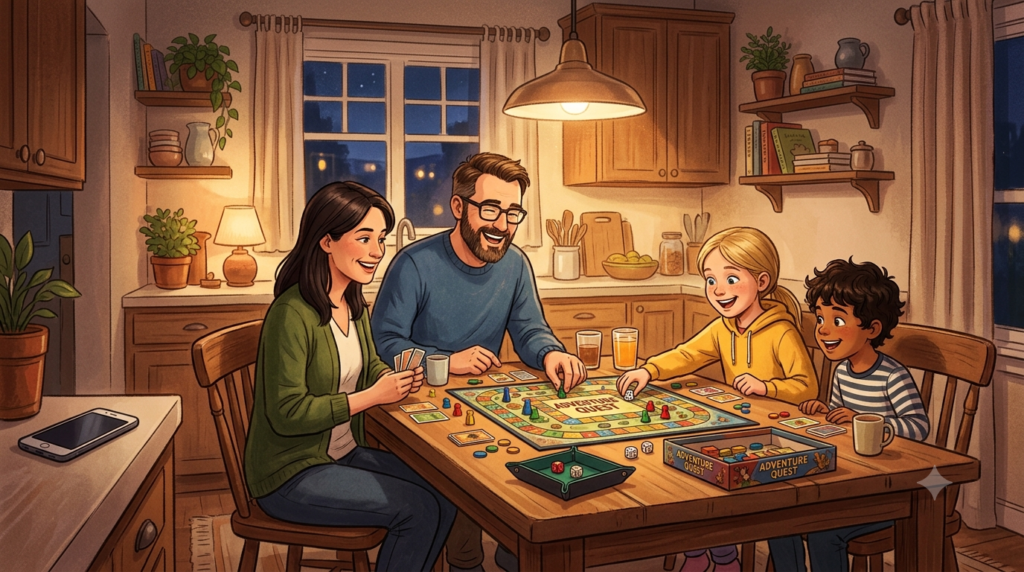
Reducing screen time only works sustainably if there’s something else to do. Outdoor time, art supplies, audiobooks, simple cooking activities, board games — the substitute needs to be genuinely engaging, not just “go outside.”
6. Model what you want to see
Children notice everything. If you’re reaching for your phone the moment boredom arrives, that behaviour is being absorbed. Parents who put their phones face-down at dinner send a message that doesn’t need words.
7. Avoid using screens as a behavioural tool
Nearly half of parents report relying on screens daily to prevent tantrums or settle a child down. It works in the short term. But over time, it trains children that discomfort — boredom, frustration, restlessness — is something to escape rather than tolerate. Building that tolerance is one of the most valuable things childhood teaches. Blueberry Pediatrics
The Bottom Line: There Is No Magic Number
You came here asking how much screen time is too much. The honest answer is: there isn’t one number that applies to every child in every family at every stage.
What the research does clearly show is this:
For children under 18 months, the closer to zero the better — outside of video calls. For toddlers and preschoolers, one hour of high-quality content with a parent present is the evidence-backed guideline. For older children, the right question to ask isn’t “how many hours?” but “is screen use interfering with sleep, school, play, and relationships?”
The type of screen time matters. The context matters. Your involvement matters enormously.
Screens are not inherently harmful. The concern is when they consistently displace the things that children need most: movement, sleep, conversation, and hands-on exploration of the world. CHOC
You don’t have to be perfect. You don’t need to eliminate devices. You just need enough information to make thoughtful choices — and you now have that.
If this post was useful, the next step is understanding how the guidelines shift at each specific age. Join us for latest post on: A Complete Guide for Parents, (0–18) breaks down in detail, from infants through to teenagers.